-
Solutions
-
 Click Fraud Protection
Block invalid clicks across every ad channel.
-
 Smart Bidding Protection
Feed Google clean, human-only signals.
-
 Clean Remarketing Audiences
Exclude suspicious traffic from your lists.
-
 All Features
Every ClickPatrol feature in one place.
-
 E-commerce & Retail
Protect shopping campaigns and product feeds.
-
 Service Providers
Stop wasted spend on local & lead-gen ads.
-
 Marketing Agencies
Classify, protect and train every client account.
-
 All Industries
Browse click fraud protection by industry.
-
 Small Business
Affordable protection that pays for itself.
-
 Enterprises
Scale protection across brands & accounts.
-
 Regional Companies
Keep local budgets on real, nearby buyers.
-
 Multinationals
Consistent protection across every market.
-
-
Agencies
-
For Agencies
Classify, protect and train every client account.
-
 Partner Program
Earn 15 to 25% recurring commission on linked clients.
-
 Case Studies
21 UK agencies unlocked over 6% media savings.
-
-
Resources
-
What is Click Fraud?
Learn what fake PPC clicks are and why they matter.
-
 Bot Traffic
Detect and block non-human clicks.
-
 Competitor Fraud
Stop rivals draining your budget.
-
 Sophisticated Fraud
Catch SIVT that native filters miss.
-
 Click Farms
Stop coordinated low-quality click operations.
-
 Invalid Traffic
Block every click that never converts.
-
 Help docs
How to connect Google Ads, GTM and other ad channels.
-
 FAQ
FAQ
Answers to the most common questions.
-
 Blog
Blog
Articles and guides from our expert team.
-
 Comparisons
ClickPatrol vs ClickCease and other tools.
-
 Tools
Tools
Free tools by ClickPatrol & Friends.
-
 About ClickPatrol™
Who we are and our mission.
-
Case Studies
Why agencies and businesses use ClickPatrol.
-
 Customer Reviews
Reviews and success stories from customers.
-
Partner Program
Join our affiliate & partner program.
-
 Contact us
Talk to our team about your ad traffic.
-
- Pricing
Keyword-level call tracking: How to optimize PPC campaigns with better attribution
Businesses use multiple SEO, PPC, and social media channels to drive leads and conversions. While clicks and form submissions are easy to track, phone calls remain an overlooked but high-value conversion metric.
Studies show that 65% of businesses consider phone calls their best-quality PPC leads, with call conversions outperforming online forms by 10-15 times. Despite these compelling numbers, many companies fail to track which keywords and campaigns drive their most profitable phone leads.
This guide will explore how call tracking software works, its impact on PPC and SEO, how to integrate it with analytics tools, and the key challenges to consider before implementation.
Keyword-level call tracking explained: How it works and why it matters
Keyword-level call tracking gives visitors a unique phone number based on the keyword they used to find your site. When a prospective buyer places a call, the system identifies the keyword that motivated the call. According to Google, 70% of mobile searchers call a business directly from search results, making keyword-level call tracking essential. Key benefits:
- Identify what keywords are driving calls
- Coordinate PPC bids and SEO strategies
- Optimize ad copy and landing pages
- Enhance customer journey insights
Unlike primitive call tracking, which allows calls to a generic source (like Google Ads or search engine results), keyword-level monitoring specifies the distinct search queries instigating telephone conversions.
One of the significant drawbacks of call tracking is compliance with data protection laws, like the GDPR. Customers' data have to be gathered carefully to assure safety and honesty.
Ensuring that your call tracking meets your company's current privacy protocols and certifications requires you to communicate closely with your security and IT teams. Even if your operations are already in compliance, ensuring they meet all current regulations is well worth it.
How does keyword-level call tracking work?
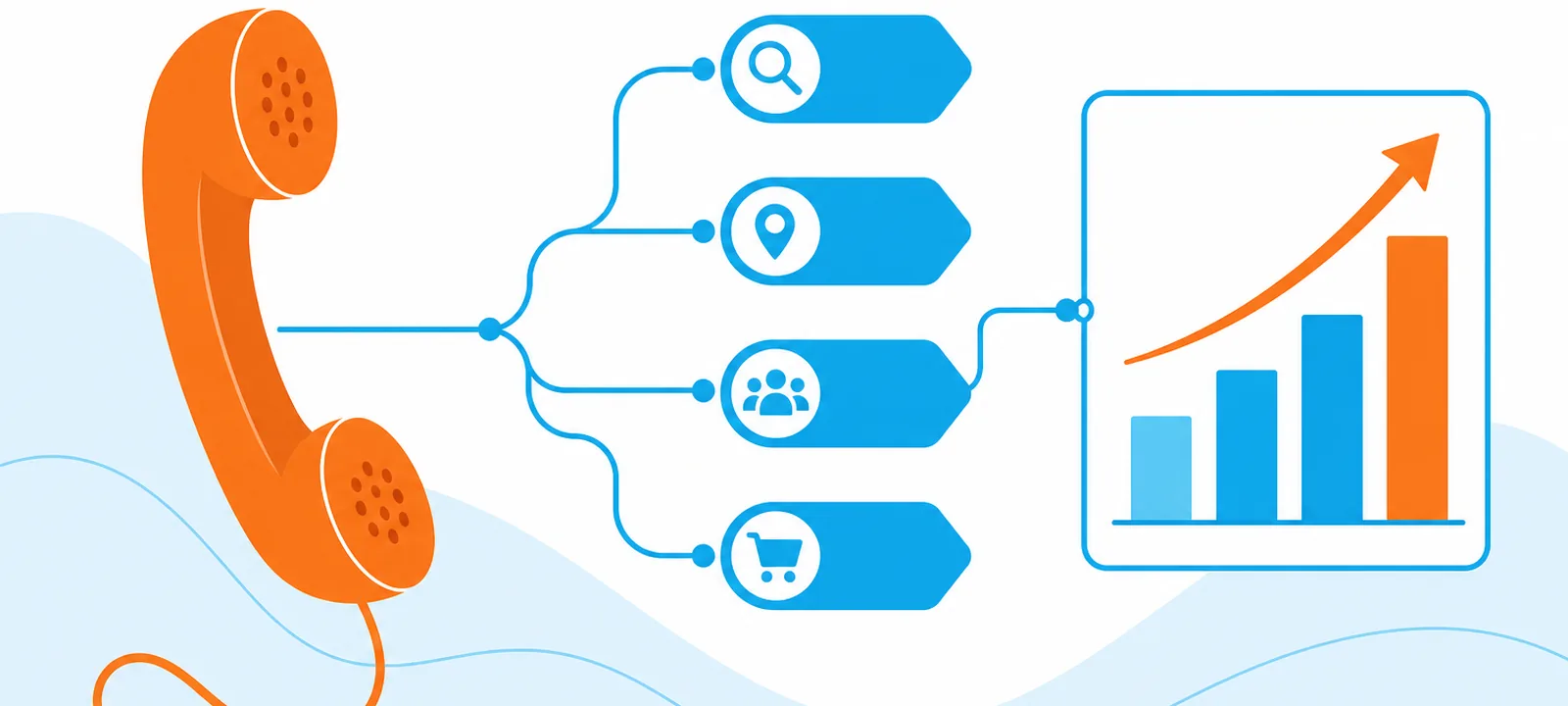
Keyword-level call tracking employs Dynamic Number Insertion (DNI) to replace the company's standard phone number with another trackable number identical to the original keyword used by the visitor. Keyword-based call attribution helps businesses track which keywords drive phone calls. It works by:
- User keyword input: A user looking for a product or service enters a keyword into the Google search engine.
- Ad or organic listing clicks: The user clicks an advert or organic listing PPC and arrives on your website.
- DNI triggers: The website displays one phone number live. This is the matched keyword.
- Customer calls the business: The visitor calls the number displayed.
- Calls are tracked and logged. Call tracking and logging of details, including the keyword, campaign source, caller ID, and call time, are done.
- Data gets fed to analytics tools: call tracking data is transmitted to Google Ads, Google Analytics, and CRM systems to analyze the data.
Common mistakes to avoid in keyword-level call tracking
1. Improper Configuration of Dynamic Number Insertion (DNI): When DNI is not working correctly, calls can be attributed to the wrong keywords. Ensure unique numbers are displayed to visitors at all times, depending on where they originate.
2. Inadequate tracking numbers: Accurate attribution is lost when many visitors share the same number. The more numbers, the better when it comes to tracking.
3. Focusing on call volume over quality: Calls might pour in by the dozen, but that doesn't mean they're worthwhile. Monitor call quality, not quantity, and examine what ultimately results in conversions.
4. Not considering the entire customer journey: Do not give credit to the last keyword before a call. Individuals engage with numerous touchpoints before converting, so utilize multi-touch attribution.
5. Not integrating with analytics and CRM: If your call data is not linked to Google Analytics, Google Ads, or your CRM, you’re missing key insights that help measure ROI and improve marketing.
Why keyword-level call tracking is crucial for PPC campaigns
Tracking calls from PPC ads is crucial for the following reasons:
- Maximize PPC spending and bidding strategy: Businesses can bid more on high-performing keywords and less on low-performing keywords. For example, you can budget if "emergency mechanic near me" drives 70% of your calls, but "best mechanic services" drives clicks with zero calls.
- Improve ad copy and landing pages: Call tracking enables you to understand which ad and landing page combinations drive the most calls to optimize further for headlines, CTAs, and copywriting.
- Optimize true ROI from phone calls: Google Ads favors click-based conversions, but other leads prefer to call rather than complete an online form. Without keyword-level tracking, businesses are losing important conversion data.
Keyword-level call tracking for SEO
Call tracking systems are mainly used in PPC operations but remain crucial to implementing SEO techniques. Organization search accounts for a significant portion of website traffic, but most visitors make direct contact by phone instead of using contact forms. 1. Utilize available tools to determine which organic search terms generate telephone contact from users.
- The users' data safety protocols established by Google Analytics obscure numerous organic search terms and label them "not provided."
- Unique call tracking at the keyword level enables businesses to retrieve untracked information.
2. Enhance the page content for relevant keywords that generate high phone calls
- Complete better optimization of the chosen web pages that attract peak phone call volume by incorporating these improvements:
- Better CTAs
- Prominent contact information
- Content optimization
3. Enhancing local search engine optimization results for companies that generate leads through phone calls should be prioritized. 4. Call tracking at the keyword level reveals what geographical search terms produce phone calls to optimize your advertising through:
- Google My Business listings
- Service pages
- Local content
Case study: How Paychex turned itself around with keyword-level call tracking
Paychex, a provider of employment and payroll services, had seen a multiyear trend of rising cost-per-acquisition (CPA) in paid search campaigns. In reaction, the firm turned on keyword-level call tracking to differentiate between phone and form leads on SEM landing pages. This created a 98% increase in lead generation and a 43% decrease in CPA. The additional phone lead data also improved testing and optimization activities, as it affected PPC bidding strategies and landing page copy.
Challenges and considerations
Keyword tracking offers excellent benefits. However, businesses must address key implementation challenges before deploying it successfully.
1. Privacy concerns
- Ensure compliance with GDPR, CCPA, and other data protection regulations.
- Practice transparency by educating customers regarding call tracking methods and obtaining necessary consent for the operation.
2. Implementation complexity
- Setting up dynamic number insertion (DNI) to integrate with existing Google Ads, Google Analytics, and CRM systems involves advanced technical complexities.
- To achieve a smooth deployment, call tracking setup requires careful planning by businesses or professional help from providers.
3. Cost factors
- Acquiring distinctive phone numbers and call-tracking software subscriptions leads to monetary expenses.
- Businesses need to analyze their potential return on investment compared to tracking expenses before committing.
Integrating keyword-level call tracking with analytics and customer relationship management software
Phone call conversion tracking of PPC campaigns is essential for lead quality and ad spend optimization. With keyword-level call tracking using Google Ads and Google Analytics, companies can track calls back to specific keywords, ad groups, and campaigns and optimize bidding strategy for improved ROI. CRM solutions integrated with products like Salesforce and HubSpot automatically route calls to sales reps based on call time, keyword intent, and engagement level. This simplifies follow-ups and increases conversion rates. With call analytics powered by AI, businesses can analyze the call transcripts to perform sentiment analysis, intent analysis, and lead qualification, thereby making smart decisions and optimizing sales outcomes.
What keyword-level call tracking cannot tell you
Keyword-level tracking answers which keyword produced the call. It does not answer whether the call was worth having, and that gap is where most of the wasted budget hides.
A campaign can look healthy at keyword level while the sales team is fielding calls that never had intent behind them: wrong-number calls from a misread ad, calls from outside your service area, or calls generated by form and click automation rather than by a person. The tracking layer records all of those as conversions, because from its point of view a call happened.
Three limitations worth being explicit about:
- Attribution needs volume. A keyword with a handful of calls per month cannot support a cost-per-lead decision, no matter how precise the tracking is.
- Call duration is a proxy, not a verdict. Short calls can be qualified buyers who already knew what they wanted, and long calls can be nobody at all.
- The data inherits whatever polluted it. If the clicks feeding a keyword were invalid, the call tracking will faithfully report a keyword that costs money and produces nothing.
The fix is not more tracking granularity. It is qualifying the outcome, then removing the sources that generate junk leads before they reach the tracking layer at all.
Best practices for keyword-level call tracking success
Best practices for keyword-level call tracking success include:
- Use different tracking numbers for every source of traffic. Ensure you can ascertain exactly where your calls are coming from using different numbers for paid advertising, organic search, and referral traffic. It will allow you to optimize your marketing more effectively.
- Quality, not quantity of calls: Many calls are great, but value comes in quality. More substantial conversations will mean more buying intent, so prioritize quality leads over quantity.
- Optimize landing pages for phone conversions: Make it easy for visitors to call you. Click-to-call buttons should be prominent, especially for mobile visitors willing to act.
- Leverage AI and automation: Let AI do the big work, scanning call transcripts for intent and sentiment. This allows you to focus on high-value leads and maximize sales efficiency.
- Maximize your bidding strategy: Take the lead in the competition by increasing bids on top-quality call-driving keywords and reducing spending on low-performing terms. Real-time bid optimization keeps your PPC campaigns running efficiently and profitably.
Unleash the full potential of your PPC and SEO with keyword-level call-tracking
Keyword-based call monitoring is a powerful business tool for optimizing PPC, ROI, SEO performance, and lead quality. With the ability to see which keywords generate calls, businesses can better optimize bidding strategy, landing pages, and conversion rates. Coupling call tracking with platforms like Google Ads and Google Analytics and CRMs like HubSpot and Salesforce allows for easy data flow, facilitating wiser decision-making. Ultimately, keyword-level call tracking bridges the gap between online searches and offline conversions, provides an end-to-end view of marketing performance, and ensures that every opportunity is tracked. Start tracking your PPC calls today—get a free demo of a keyword-level call-tracking solution.
FAQs
Q.1 Is call tracking at a keyword level only for PPC campaigns?
No, it can also be useful for SEO and local search optimization.
Q. 2 How does dynamic number insertion (DNI) work?
DNI seamlessly replaces your website's visible phone number with one synchronized with the visitor's traffic source and keyword.
Q. 3 Will call tracking affect my SEO rankings?
No, as long as it is done correctly with DNI, it will not impact search rankings.
Q. 4 How much does keyword-level call tracking cost?
The cost depends on the provider, the size of the tracking numbers, and the degree of integration required. Most businesses believe that the ROI outweighs the expense.
Q. 5 Which PPC platforms support keyword-level call tracking?
PPC platforms like Google Ads, Bing Ads, Meta Ads, TikTok Ads, and LinkedIn Ads support keyword-level call tracking.

Written & reviewed by
Abisola Tanzako
Content Manager, ClickPatrol (click fraud & invalid-traffic specialist)
Abisola covers bot traffic, ad fraud and PPC protection, drawing on ClickPatrol platform data from 1,793+ businesses.
Last updated: 6 October 2026