
 English
 Nederlands
30 to 40% more bad traffic from Meta
Compared with a year earlier, in the Netherlands. An estimate: Meta shares impressions rather than click data, so ClickPatrol works the share out from the visits it labels on advertisers' sites.
ClickPatrol labels every Meta ad visit on your site as legitimate or suspicious. You turn those labels into two Custom Audiences: one you exclude from your ad sets, one you build lookalikes on.
Done. We are opening your account.
Sent. Look in your inbox and create your account whenever it suits you.
ClickPatrol in Emerce: bad Meta traffic in the Netherlands up 30 to 40% on last year
 4.9
 4.5
Google Certified Click Tracker
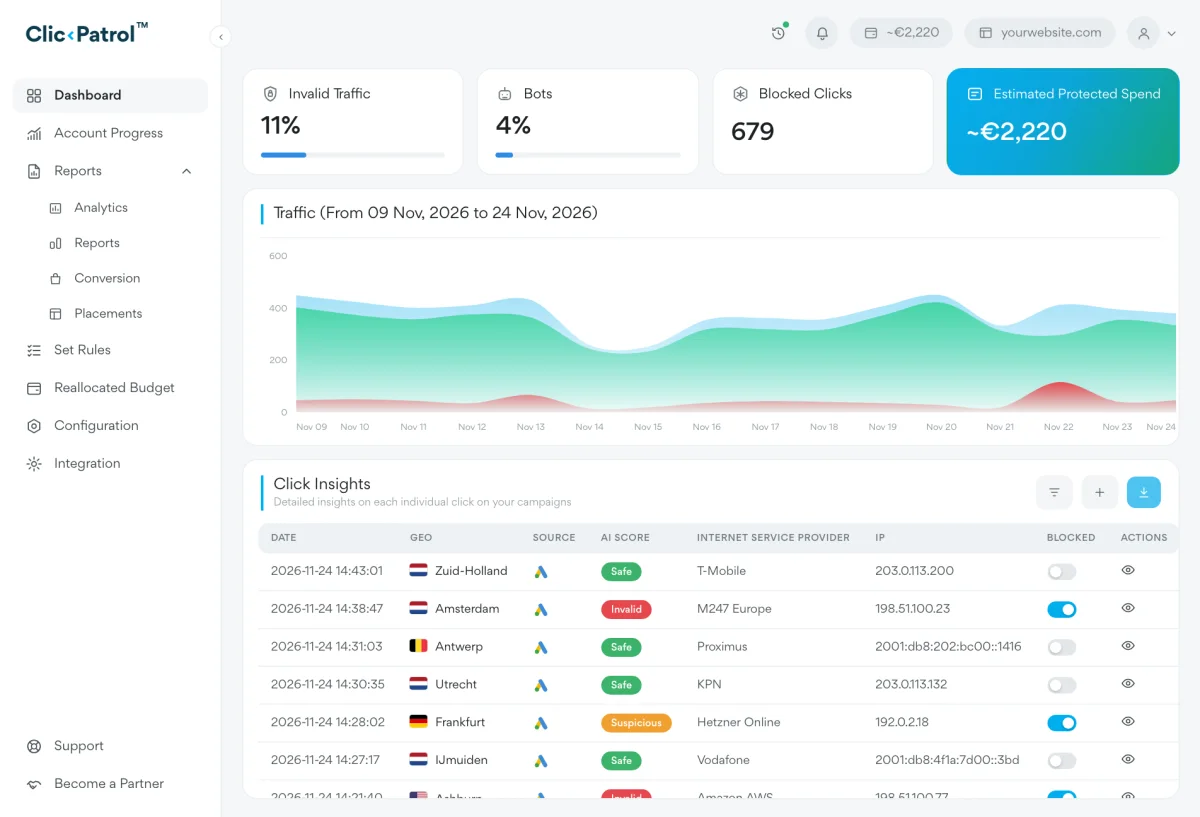
ClickPatrol scores each Meta ad visit on your site, and your Meta Pixel turns the suspicious ones into an audience you exclude, so those visitors drop out of your ad sets.
Ads Manager, with and without
For a team that lives on form fills, the Lead event is where a bot does the most damage, because Meta learns from it. More on click fraud protection for lead generation.
| Topic | Ads Manager on its own | With ClickPatrol |
|---|---|---|
| A visitor that is not a person | Counts as a link click and a landing page view, and can end up in your website audiences. | Gets the ClickPatrol_Suspicious label and lands in an audience you exclude. |
| The Lead event | Fires for whoever completes the form, bots included, and delivery goes looking for more of the same. | Fires only when the visit was labelled legitimate, so Meta optimises on enquiries from people. |
| Lookalike seed | Everyone who converted, junk form fills and all. | Converters whose visit passed. Aim for at least 1,000 people in the seed; 5,000 is better. |
| Retargeting | Everyone the pixel recorded on your site. | Legitimate visitors, combined with what they did there, such as a pricing page view without an enquiry. |
| The following week | Nothing stops the same suspicious visitors from being reached again. | They sit in CP Suspicious 30d, excluded from the ad sets you pick. |
An excluded audience is not an IP block. It covers the visitors your Meta Pixel recorded with the suspicious event, for the retention window you set on the audience.
How it works
Your bids, budgets and creatives stay as they are. ClickPatrol adds a URL parameter string, two events and two audiences.
1Tag
Copy the UTM template from the Meta(fb/ig) tab under Integration and paste it into the URL parameters field of each ad. Meta fills in the campaign, ad set, ad and placement at the moment of the click, and source=f tells ClickPatrol the visit came from Meta.
2Label
The ClickPatrol tag in Google Tag Manager checks device, network and behaviour on each ad visit and pushes ClickPatrol_Legitimate or ClickPatrol_Suspicious. A Meta Pixel tag forwards those events. Meta holds any new custom event back until you confirm it in Events Manager, which you do once.
3Exclude
In Audiences, create a Custom Audience from your pixel on ClickPatrol_Suspicious, named something like CP Suspicious 30d, and exclude it in your ad sets. A second one on ClickPatrol_Legitimate becomes your lookalike seed. Every click of the way is in the Meta audiences guide.
ClickPatrol data
Figures ClickPatrol shared with Emerce for an article on click fraud in the Netherlands, published 28 October 2026.
Compared with a year earlier, in the Netherlands. An estimate: Meta shares impressions rather than click data, so ClickPatrol works the share out from the visits it labels on advertisers' sites.
Bot clicks tell the algorithm a campaign works. The advertiser then adds lookalikes of those clickers and pays again to reach audiences that are fake or of poor quality.
Across every paid channel in the Netherlands, not Meta alone. Google came out best of the networks ClickPatrol monitors; Facebook and OpenAI Ads sent the worst traffic.
Source: Erwin Boogert, "Klikfraude in Nederland stijgt 21%, OpenAI Ads al in de top vier", Emerce, 28 October 2026 (in Dutch).
Get started
Nothing in your campaigns changes until you exclude the audience yourself.
Verify your payment method with €0.01, then import the ClickPatrol template from the Google Tag Manager gallery and fire it on All Pages.
In Ads Manager, open each ad and add the string from the Meta(fb/ig) tab to URL parameters. Meta visits then show up under Reports.
Forward both events to your Meta Pixel, confirm them in Events Manager, then create CP Suspicious 30d and exclude it.
Reviews
4.974 reviews 5.018 reviews
 5.051 reviews4.523 reviews
“Customer support is friendly and responsive. Setup was simple, and the reports are visually excellent. Real-time protection runs smoothly.”
“ClickPatrol feels like a tool designed by people who actually understand digital marketing pain points. The UI is clean, the fraud detection is accurate, and I can prove ROI improvements quickly to stakeholders.”
“Not much to say other than it simply works. Setup was quick, it runs quietly in the background, and our ad spend is being used more efficiently now. Exactly what you’d want from a tool like this.”
Read at the source on 16 November 2026 for G2, 4 November 2026 for Capterra and SourceForge, and 11 August 2026 for Trustpilot. Read all customer reviews
Questions
No. On Google Ads, ClickPatrol adds the IP addresses behind invalid clicks to your campaign exclusions. It has no such route into Meta, so it labels each visit on your own site instead. You then exclude the suspicious audience in your ad sets, and Meta stops spending on those visitors there.
The label does not rest on an IP address. Device, network and behaviour signals are weighed together, so one shared office or mobile network does not mark everyone on it. In a low-volume account, exclude the audience in a single campaign first and watch cost per lead for two to four weeks before rolling it out.
Only for clicks that reach your website. An Instant Form is filled in inside Facebook or Instagram, so the ClickPatrol tag never sees that person. Lead ads that send people to a landing page are covered, and there you can fire the Lead event only for visits labelled legitimate.
Not on its own. The legitimate-only trigger lives in Google Tag Manager, so an event sent server-side through the Conversions API, or by a platform app outside GTM, still reaches Meta from suspicious visits. Gate it in the system that sends it, or send that event from GTM instead.
Meta holds back every new custom event until the advertiser confirms it. Open Events Manager, choose the pixel, go to Settings and then Data restrictions, and review the events under Manage custom event blocking. Confirm ClickPatrol_Legitimate and ClickPatrol_Suspicious, and both become available for audiences and optimisation.
Add the tag and the UTM template, run your ads as usual for a week, and see how many Meta visits ClickPatrol labels suspicious before you exclude anything. Cancel inside the 7 days and you owe nothing more.
Done. We are opening your account.
Sent. Look in your inbox and create your account whenever it suits you.