
 English
 Nederlands
Smart Bidding protection A bot that fills in your form teaches Google to find more bots.
Smart Bidding learns from every conversion you report, form fills from bots included. ClickPatrol scores each ad visit, so Google Ads can bid on a conversion that only counts the real ones.
Done. We are opening your account.
Sent. Look in your inbox and create your account whenever it suits you.
daar-om.nl, a Dutch Google Ads agency: 10% more leads for its client Giordano
 4.9
 4.5
Google Certified Click Tracker
Smart Bidding protection, in short
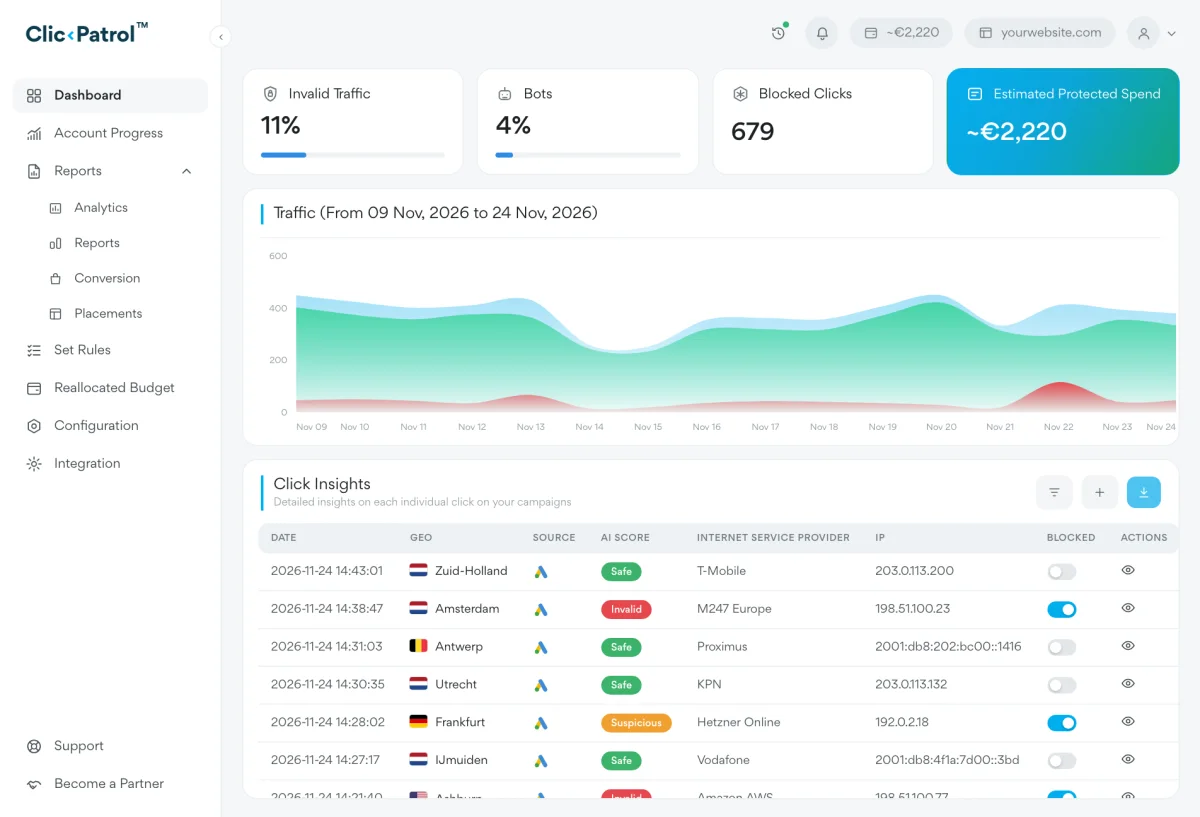
ClickPatrol scores each ad visit, and a second conversion action that fires only on legitimate visits lets Smart Bidding bid on leads from people, not bots.
- Why Smart Bidding needs it
- It bids on what you report. Google drops the invalid conversions it detects; a bot form fill it misses still counts as a lead and steers the bidding. How invalid clicks break Smart Bidding
- What ClickPatrol does
- Scores the visit before the form. Its verdict sits in a cookie, and your new conversion counts only leads from legitimate ad visits. With protection on, invalid sources are also excluded.
- Where it stops
- Bids and budgets untouched. ClickPatrol never changes them. The verdict lasts 24 hours in one browser, so a later or cross-device lead counts only on your original action.
- What stays as it is
- Your current conversion stays. It moves to secondary, so nothing disappears from reports. Never make both actions primary in one campaign, or one lead counts twice.
- Price and trial
- From €71 a month, €59 billed yearly. A 7-day trial after a €0.01 verification; cancel within the week and pay nothing more. Compare plans
Two conversion actions
One lead form, counted twice: once for reporting, once for bidding
You keep the conversion you have and add a stricter one next to it. The difference between the two columns is what Smart Bidding stops learning from.
| Topic | Your current conversion | Legitimate-only conversion |
|---|---|---|
| Fires when | Someone completes the form or reaches the thank-you page. | At the same moment, but only if ClickPatrol scored that ad visit as legitimate. |
| A bot fills in the form | It counts as a lead and becomes part of what the campaign bids towards. | Nothing is counted for it. |
| Role in Google Ads | Moves to secondary. It stays visible under All conversions, but bidding ignores it. | Becomes the primary action in the campaigns that should bid on real enquiries. |
| Target CPA | Calculated over a lead count that includes junk. | Set again from what this action reports. It records fewer leads, so the old target would be too strict. |
| Gaps | None. It counts everyone, which is exactly the problem. | A lead after the 24-hour window, on a second device or without consent is not counted here. The original action still has it. |
Never make both actions primary in the same campaign: one lead would then count twice. Google uses primary actions for bidding and keeps secondary ones for observation (Google Ads Help, read 10 November 2026).
How it works
From a scored visit to a cleaner bid signal
Three parts, all in accounts you already own: Google Tag Manager, Google Ads and, if you use it, GA4.
1Score
Every ad visit gets a verdict before the form
When a visitor arrives from one of your ads, the ClickPatrol tag classifies the visit and writes the result, legitimate or suspicious, to a cookie on your own domain. Organic and direct visitors get no cookie, because ClickPatrol only classifies ad traffic.
- Readable on every later page, the thank-you page too
- Valid for 24 hours after the visit
- Checks device, network and behaviour, never the IP alone
2Count
Google Ads bids on leads from real visits
In GTM you read the cookie as a variable, copy the trigger of your lead tag and add one condition: the visit is legitimate. Attach it to a new conversion action. The exact steps are in the help article. Run the new action as secondary for a week or two, compare it with the original, then make it primary per campaign. Prefer GA4? Import a key event such as generate_lead_legitimate instead, not both. The same logic sits behind stopping junk leads before they reach your CRM.
- A form on the landing page itself: use a Trigger Group with the ClickPatrol_Legitimate event
- Works for Search, Display and Performance Max bidding
- The same trigger can gate a Meta Pixel lead event
3Exclude
The sources stop reaching your form
Counting cleanly is half of it. With protection on, ClickPatrol puts the IP address behind an invalid click on the exclusion list of the campaign it hit, or on the account list where Google offers no campaign list, as with Performance Max. That is the part covered by Google Ads click fraud protection, and it means fewer bots get to the form in the first place.
- Exclusions visible in your own Google Ads settings
- Monitor Only Mode if you want to watch first
- Whitelist any IP under Configuration
Results
An agency that cleaned up the leads it reports on
daar-om.nl runs Google Ads for Dutch SMEs and found invalid clicks of up to 20% on some client accounts.
 Agency
- +10%
- leads for client Giordano
- +58%
- time on page for Giordano
- Up to 20%
- invalid clicks on some accounts
We’re a marketing agency, and we rolled out ClickPatrol on a number of client accounts. It's been reliable, and the multi account setup works well. In some cases, we added fraud protection without telling our clients, they saw performance improvements first.
Get started
Protect Smart Bidding in three steps
Connecting Google Ads takes about 2 minutes. The conversion action is one extra change in Google Tag Manager, which you make when you are ready.
Start the trial
Use your work email and verify your payment method with €0.01. For 7 days ClickPatrol measures; nothing else is billed.
Connect Google Ads
Sign in with Google, pick the account or the client under your MCC, and ClickPatrol places its tracking template. Add the ClickPatrol tag to Google Tag Manager next to it.
Add the legitimate conversion
In Google Tag Manager, create a variable that reads the ClickPatrol cookie, copy your lead trigger, add the condition that the visit is legitimate and attach a new conversion action. Keep it secondary until the numbers make sense to you, then switch it to primary.
Reviews
Advertisers who care about cost per real lead
4.974 reviews 5.018 reviews
 5.051 reviews4.523 reviews
Wish I knew about click fraud earlier
“I run a small law firm and spend a fair amount on Google Ads. I had no idea how much of the budget was being wasted until a marketing consultant recommended ClickPatrol. Seeing the data was eye-opening. Our cost per acquisition has gone down significantly, and I finally feel like I’m getting proper value from my ad spend.”
Our Single Source of Truth for Ad Traffic Quality
“ClickPatrol has become the definitive source for our paid traffic quality data. Its reliability is what allows my team to operate with confidence. We no longer have to cross-reference data from multiple tools or doubt the numbers in our reports.”
Protects Every Marketing Dollar!
“Real-time fraud detection and blocking. Improves lead quality by filtering fake sign-ups. Detailed analytics to optimize campaigns. Alerts notify suspicious activity immediately. Multi-platform integration. Helps reduce wasted ad spend and improves ROI.”
Read at the source on 16 November 2026 for G2, 4 November 2026 for Capterra and SourceForge, and 11 August 2026 for Trustpilot. Read all customer reviews
Questions
Before you change what Smart Bidding learns from
Will my conversion numbers drop?
On the new action, yes, and that is the point: form fills from suspicious visits are no longer counted. Your original action keeps its full count as a secondary action. Base any target CPA on what the new action reports, because a target copied from the old one will be too strict.
Can I test this before my campaigns bid on it?
Yes. Create the legitimate action as secondary and leave bidding untouched for a week or two. You see both counts side by side in Google Ads. When the gap looks right, make the new action primary for a campaign and set the original to secondary there.
What about leads who convert days after the click?
The verdict lasts 24 hours and lives in one browser. A lead who comes back two days later without clicking an ad again, or switches from phone to laptop, is not counted on the legitimate action. Your original action still records them, which is why you keep both.
Is a legitimate lead the same as a qualified lead?
No. Legitimate means the visit came from a real person, not a bot or a click farm. It says nothing about whether that person fits your business. If your sales team scores leads, those scores stay the stronger signal; this removes the visits that were never people at all.
Does ClickPatrol change my bids or campaign settings?
No. It places a tracking template and, once protection is on, writes IP exclusions. The conversion action is yours: you create it in your own Google Ads account and decide where it is primary. See click fraud protection for lead generation for the wider setup.
We send conversions server-side too. Are those covered?
Only what passes the GTM trigger is gated. A lead event sent through the Meta Conversions API or a platform app outside Tag Manager still reaches Meta from suspicious visits. Gate it in the system that sends it, or send that event from GTM only.
Let Smart Bidding learn from people, not bots
Connect Google Ads, look at a week of scored visits and add the legitimate conversion when you trust what you see. Stop within the 7 days and you pay nothing beyond the €0.01 verification.
Start your 7-day free trial
Done. We are opening your account.
Sent. Look in your inbox and create your account whenever it suits you.