
 English
 Nederlands
24 hours
A classification is kept for 24 hours. A lead that converts a day later without a new ad click arrives as not classified.
When bots fill your forms, cost per lead looks better than it is. ClickPatrol excludes invalid sources, labels every lead legitimate or suspicious in your CRM and lets you bid on the legitimate ones.
Done. We are opening your account.
Sent. Look in your inbox and create your account whenever it suits you.
Want to walk through your lead flow with us first? Book a demo
daar-om.nl client Giordano: +10% leads
 4.9
 4.5
Google Certified Click Tracker
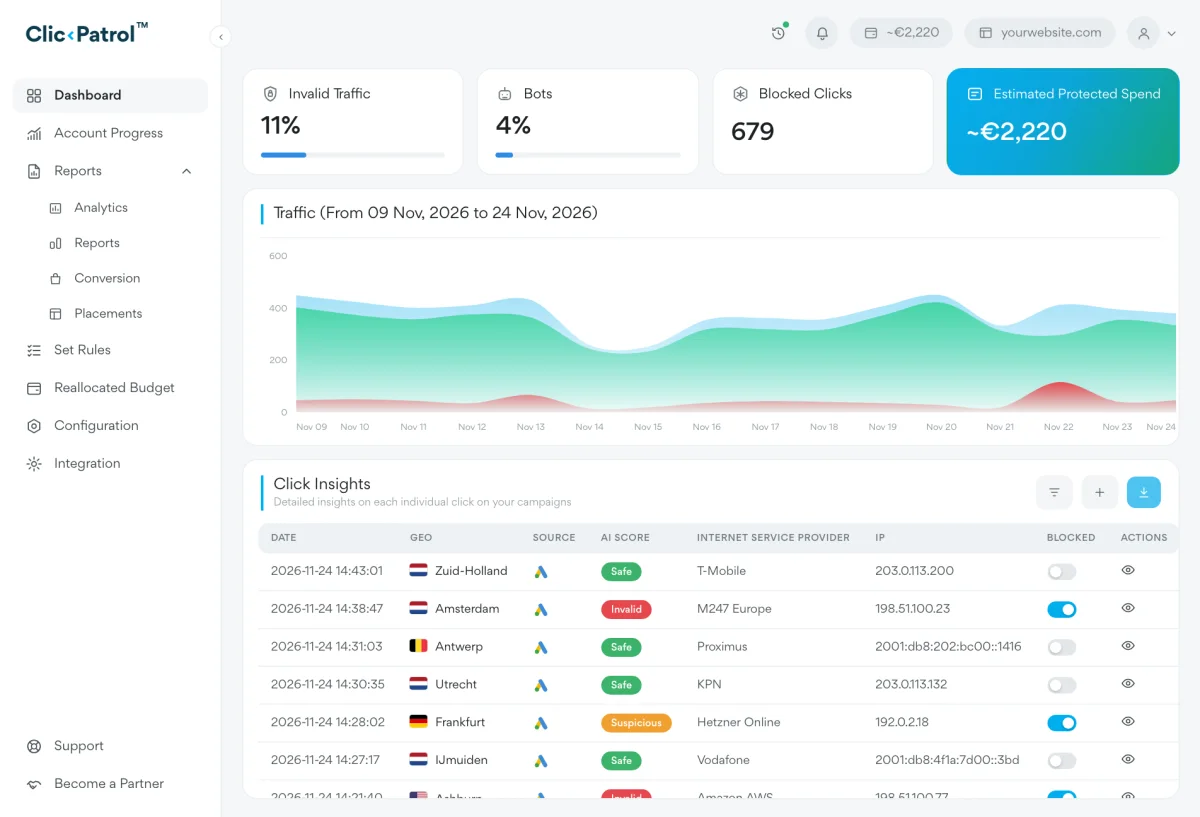
ClickPatrol scores the ad click behind every form fill, excludes invalid sources in Google Ads and labels each lead legitimate or suspicious in your CRM.
The problem
A lead campaign is judged on one number, and that number divides spend by every form that came in. Submissions from bots and click farms make it look cheaper than it is, then sales finds out on the phone. Smart Bidding has already learned from those submissions and goes looking for more.
The fix is to know, per lead, whether a real visit came before the form. Recognise the pattern from sales complaints, empty pipelines and lead scores that make no sense? Those signs are on the page about junk leads. This page is about running a lead operation on the label.
Cost per lead against cost per real lead
How it works
Three layers, set up in this order. The first works on its own; the second and third use the ClickPatrol tag in Google Tag Manager.
1Exclude
Every click on your lead campaigns is checked on device, network and behaviour before the landing page loads. Sources scored as invalid are excluded in Google Ads, so the same bot cannot click again and fill in a second form tomorrow.
2Label
A small Tag Manager tag fills a hidden field in your form with the ClickPatrol classification just before the form is sent. Sales sees it on the contact record, and your reports can split leads by campaign and label.
3Bid
Create a second conversion action that only fires when the visit was scored as legitimate. Run it as secondary for a week or two next to your current action, then make it primary per campaign. Expect fewer conversions on it, and set target CPA on what it reports.
Reading the label
Three values can land in the CRM field. Each one asks for a different follow-up.
| Label | What it tells you | What to do with it |
|---|---|---|
| Legitimate | The visit before the form was scored as a real person. | Send it to sales and include it in offline conversion uploads. |
| Suspicious | The visit before the form was scored as invalid traffic. | Route it to a review list, check it, and keep it out of uploads so bidding never learns from it. |
| Not classified | No verdict: an organic or direct visit, an ad click more than 24 hours earlier, or a click on another device. | Treat it as you do today. It is not a good or a bad sign. |
Limits
Worth knowing before you build reports on it.
A classification is kept for 24 hours. A lead that converts a day later without a new ad click arrives as not classified.
The label lives in the browser of the visit. Someone who clicks on a phone and fills in the form on a laptop is not classified.
If your consent banner holds the ClickPatrol tag back until consent, visitors who decline are never classified.
The label says a person filled in the form. Whether that person fits your business is still for your own lead scoring to decide.
Case study
The Dutch agency runs Google Ads for SMEs. One client, Giordano, sells packaging and logistics to the egg industry and depends on enquiries.
 Lead generation
We had difficulty estimating the amount of invalid traffic our customers receive on their campaigns, and we also had no idea how to exclude all of them properly.
Reviews
4.974 reviews 5.018 reviews
 5.051 reviews4.523 reviews
“Real-time fraud detection and blocking. Improves lead quality by filtering fake sign-ups. Detailed analytics to optimize campaigns. Alerts notify suspicious activity immediately. Multi-platform integration. Helps reduce wasted ad spend and improves ROI.”
“We were skeptical at first because we thought Google already filters out invalid clicks. Turns out they miss a LOT. ClickPatrol showed us exactly what was slipping through. After 3 months of use our lead quality is way up and we're spending less to get the same results. Can't imagine running ads without it now.”
“Customer support is friendly and responsive. Setup was simple, and the reports are visually excellent. Real-time protection runs smoothly.”
Read at the source on 16 November 2026 for G2, 4 November 2026 for Capterra and SourceForge, and 11 August 2026 for Trustpilot. Read all customer reviews
Get started
Exclusions run as soon as Google Ads is connected. The CRM field and the legitimate conversion follow in Tag Manager when you are ready for them.
Enter your work email and verify your payment method with €0.01. Nothing else is billed in the 7 days.
Sign in with Google and ClickPatrol places the tracking template. Already use HubSpot ad tracking? Merge the two templates first, then switch off HubSpot's auto tracking.
Install the ClickPatrol tag in Google Tag Manager, add the hidden field to your form and send a test lead with ?source=f on the URL to see the label arrive.
Questions
On the new legitimate conversion action, yes, and that is the point: it leaves out leads from suspicious visits. Keep your original action next to it as secondary, compare the two for a week or two, and base target CPA on the legitimate action instead of copying the old target.
Yes. In HubSpot you add a single-line text property as a hidden form field; in Salesforce a custom field on the Web-to-Lead form. The form has to be part of the page: a Tag Manager tag cannot fill a field inside an iframe, which some HubSpot embeds use.
ClickPatrol classifies visits that reach your website, through the ClickPatrol tag and the UTM template on your Meta ads. A lead form that opens and submits inside Meta never loads your site, so it gets no label. Ads that send people to your own landing page do.
Yes. Monitor only mode scores every click without sending exclusions to Google Ads, and the legitimate action can run as secondary while campaigns bid as before. For a clean read, compare against a control: a geo split or a 4 to 6 week before and after period.
No. Legitimate means a real visitor filled in the form. Whether they fit your offer is still for your own lead scoring and sales team. The label removes the bot and click-farm submissions so qualification starts from real people. More on lead generation fraud beyond the ad click.
Start the trial, connect Google Ads and see how many of this week's clicks came from invalid sources. Comparing tools first? Read how click fraud protection works across platforms, or book a demo and bring your lead flow.
“ClickPatrol has become the definitive source for our paid traffic quality data. Its reliability is what allows my team to operate with confidence. We no longer have to cross-reference data from multiple tools or doubt the numbers in our reports.”
Done. We are opening your account.
Sent. Look in your inbox and create your account whenever it suits you.