Google Search for capturing existing demand, and Microsoft Advertising when you want the same intent at a lower cost per click. Start with one platform. Spreading a small budget across three gives none of them enough data to optimise.
-
Solutions
-
 Click Fraud Protection
Block invalid clicks across every ad channel.
-
 Smart Bidding Protection
Feed Google clean, human-only signals.
-
 Clean Remarketing Audiences
Exclude suspicious traffic from your lists.
-
 All Features
Every ClickPatrol feature in one place.
-
 E-commerce & Retail
Protect shopping campaigns and product feeds.
-
 Service Providers
Stop wasted spend on local & lead-gen ads.
-
 Marketing Agencies
Classify, protect and train every client account.
-
 All Industries
Browse click fraud protection by industry.
-
 Small Business
Affordable protection that pays for itself.
-
 Enterprises
Scale protection across brands & accounts.
-
 Regional Companies
Keep local budgets on real, nearby buyers.
-
 Multinationals
Consistent protection across every market.
-
-
Agencies
-
For Agencies
Classify, protect and train every client account.
-
 Partner Program
Earn 15 to 25% recurring commission on linked clients.
-
 Case Studies
21 UK agencies unlocked over 6% media savings.
-
-
Resources
-
What is Click Fraud?
Learn what fake PPC clicks are and why they matter.
-
 Bot Traffic
Detect and block non-human clicks.
-
 Competitor Fraud
Stop rivals draining your budget.
-
 Sophisticated Fraud
Catch SIVT that native filters miss.
-
 Click Farms
Stop coordinated low-quality click operations.
-
 Invalid Traffic
Block every click that never converts.
-
 Help docs
How to connect Google Ads, GTM and other ad channels.
-
 FAQ
FAQ
Answers to the most common questions.
-
 Blog
Blog
Articles and guides from our expert team.
-
 Comparisons
ClickPatrol vs ClickCease and other tools.
-
 Tools
Tools
Free tools by ClickPatrol & Friends.
-
 About ClickPatrol™
Who we are and our mission.
-
Case Studies
Why agencies and businesses use ClickPatrol.
-
 Customer Reviews
Reviews and success stories from customers.
-
Partner Program
Join our affiliate & partner program.
-
 Contact us
Talk to our team about your ad traffic.
-
- Pricing
Best PPC Sites in 2026: Platforms, Costs & Strategies to Maximize ROI
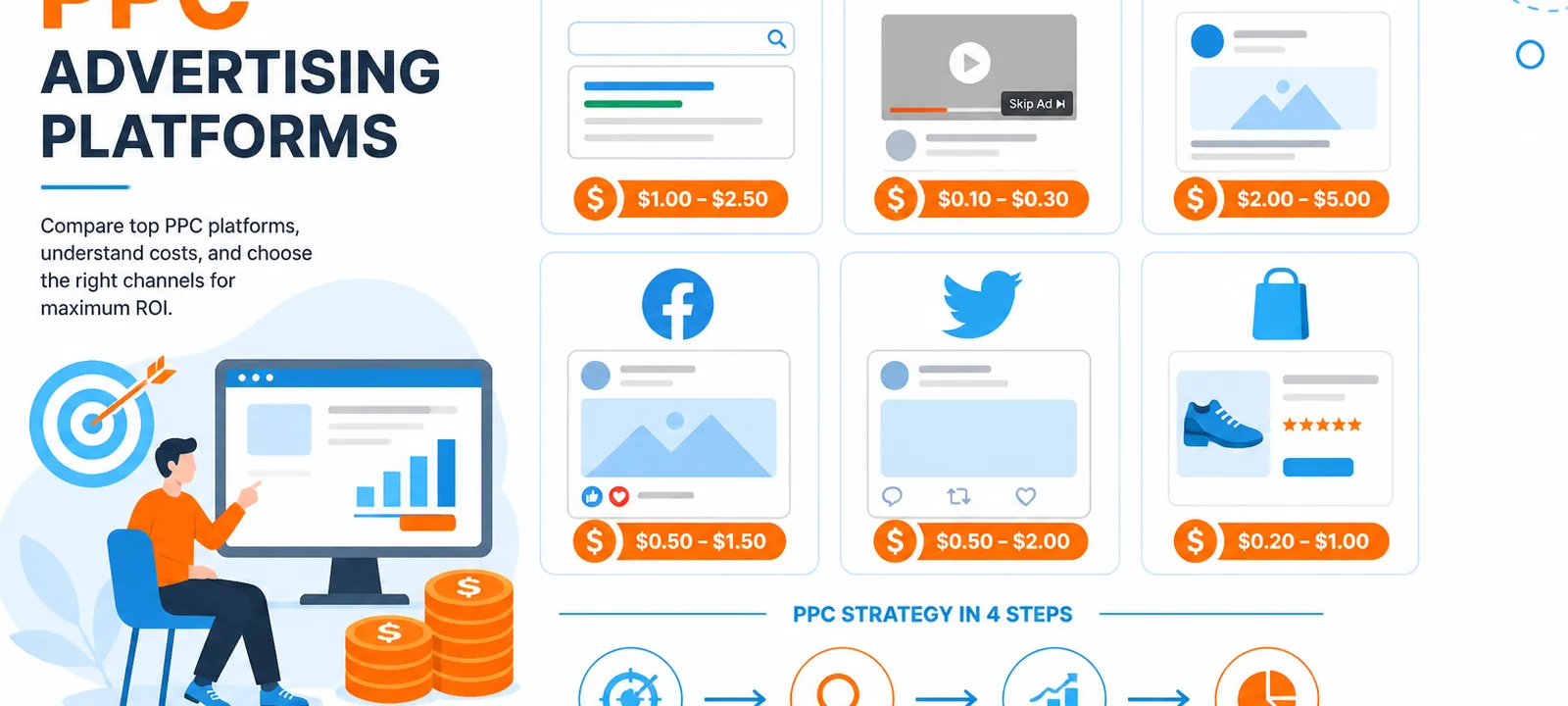
The PPC sites worth advertising on in 2026 are Google Ads for search intent, Microsoft Advertising for the same intent at a lower price, Meta for demand you have to create, LinkedIn for B2B targeting by job title, Amazon for physical products, and TikTok for younger audiences. Which one is right depends on whether your customer is already searching for what you sell.
That single question settles most platform arguments. Search platforms capture existing demand. Social platforms create it. Running a social campaign for a service people only look for in an emergency wastes money, and so does running search ads for a product nobody knows exists yet.
PPC platforms compared
| Platform | Average CPC | Best for | Main drawback |
| Google Ads | $1 to $7 | Existing search demand, any sector | Most competitive, so the most expensive |
| Microsoft Advertising | $0.50 to $3 | Same intent, cheaper, older audience | Roughly 4% of global search volume |
| Meta | $0.50 to $2 | Visual products, interest targeting | Tracking weakened by privacy changes |
| $0.40 to $1.50 | Fashion, beauty, travel, lifestyle | Needs genuinely good creative | |
| $2 to $8 | B2B, targeting by job title and company | Highest cost per click of the major networks | |
| Amazon Ads | Around $1 | Physical products, buyer already shopping | Only useful if you sell on Amazon |
| TikTok | $0.10 to $1 | Under-30 audiences, video-led offers | $50 daily minimum, creative-hungry |
How PPC advertising works
You choose keywords or an audience, set a maximum you are willing to pay for a click, and the platform runs an auction each time someone qualifies. You pay only when somebody clicks.
The auction is not won by the highest bid. Ad Rank multiplies your bid by a quality assessment covering expected click-through rate, how well the ad matches the query, and the landing page experience. A smaller advertiser with a tightly relevant ad can outrank a larger one paying more, and you are charged the minimum needed to hold your position rather than your maximum bid.
That mechanism is broadly the same across search platforms. The differences are in the size of the audience, what targeting data the platform holds, and how much competition there is for the same person.
Google Ads
The largest network by a wide margin, reaching about 90% of internet users and covering Search, Display, YouTube, Shopping and Performance Max from one account.
Use it when people already search for what you sell. Someone typing "emergency locksmith Manchester" has decided to buy, and no amount of creative on another platform reaches that person at that moment.
The costs are the highest of any search platform and the account needs regular attention. An unmanaged Google Ads account does not stay level, it gets gradually worse, because search terms drift and competitors adjust.
Microsoft Advertising
Runs across Bing, Yahoo and AOL, holding around 4% of global search. Small, and that is the point: the same commercial searches at 20 to 30% below Google prices, with fewer advertisers in each auction.
The audience skews older and higher income, which suits B2B, financial services and considered purchases. LinkedIn profile targeting is available here and nowhere else in search advertising, so you can layer job function or industry onto a keyword.
The practical case for it is that you can import an entire Google Ads account in a few minutes. If Google is profitable, Microsoft usually is too, on a fraction of the budget and with less work.
Meta: Facebook and Instagram
Facebook has around 3 billion monthly users and Instagram 1.6 billion. Nobody on either is searching for your product, which changes what the ads have to do.
Targeting is by demographics, interests and behaviour rather than intent, so the creative has to interrupt someone and interest them. That suits visual products, impulse purchases and offers that can be explained in one image.
Two practical constraints. Apple's privacy changes made conversion tracking less reliable, so reported results and actual results diverge more than they used to. And creative fatigue is real: the same ad shown to the same audience for six weeks stops working, which means an ongoing production cost that search campaigns do not have.
LinkedIn Ads
The only platform where you can target by job title, seniority, company size and industry with any accuracy. For a product sold to a specific role in a specific kind of company, that is worth paying for.
And you will pay. Clicks run $2 to $8 and often higher in competitive B2B categories. The maths only works where a customer is worth thousands, which is most enterprise software and professional services and very little else.
Lead gen forms fill from the user's profile, which lifts completion rates and lowers lead quality at the same time. Somebody who submitted a form in two taps has not thought about it much.
Amazon Ads
For physical products, the highest purchase intent available anywhere. People on Amazon are shopping, not browsing, and average CPC sits below a dollar.
Sponsored Products appear in search results, Sponsored Brands promote a range, and display inventory reaches beyond Amazon itself. Attribution is direct, since the platform sees the sale.
The obvious limit: it only works if you sell on Amazon, and in crowded categories the auction is competitive enough that margins get thin.
TikTok Ads
Cheap clicks and high engagement among under-25s, with a $50 daily minimum that puts it out of reach for the smallest budgets.
The platform rewards content that does not look like advertising, so a polished commercial performs worse than something filmed on a phone. Businesses without in-house creative capacity tend to struggle here regardless of budget.
How to choose
Start with the search question. Do people search for what you sell? If yes, start with Google Ads or Microsoft Advertising. If no, start with Meta or TikTok.
Then check the maths. Take your customer value, assume a 2 to 5% conversion rate, and see what CPC still leaves a margin. LinkedIn at $8 a click needs a customer worth several thousand.
Then look at what you can produce. Search ads need text. Social ads need a stream of new creative. Pick the platform you can actually feed.
Then start with one. Splitting a small budget across three platforms gives each too little data to optimise, and you learn nothing about any of them. The full comparison by campaign type is in ad platforms we protect.
What PPC costs by industry
| Industry | Average Google Ads CPC |
| Legal services | $6.75 |
| Finance and insurance | $5.16 |
| Health and medical | $2.62 |
| Travel and hospitality | $1.55 |
| Ecommerce | $1.16 |
Price tracks customer value. Where one client is worth thousands, every advertiser can justify a high bid and the clearing price rises until the least patient bidder drops out. Individual terms go much further than the averages suggest: "best credit cards" and comparable finance keywords pass $50 a click.
Geography moves it as well. The same keyword costs more in London or New York than in a smaller market, and more in developed economies than in emerging ones. Budget guidance by business size is in PPC advertising costs explained.
Getting more from the budget
- Use long-tail keywords. "Waterproof running shoes for wide feet" has fewer bidders and clearer intent than "running shoes".
- Build the negative keyword list before you spend, then add to it weekly from the search terms report.
- Send each ad group to a page about that specific thing. Homepage traffic converts worst on every platform.
- Set up remarketing. Returning visitors cost less and convert better than first-time clicks.
- Cut bids on hours and locations that produce clicks and no conversions rather than lowering bids everywhere.
Mistakes that cost the most
No defined conversion. If you have not decided whether you are buying traffic, leads or sales, the platform will optimise toward whatever is easiest to produce, which is usually clicks.
Set and forget. Search terms drift, competitors enter, seasonality shifts. An account left alone for three months is buying something different from what it was set up to buy.
Chasing the cheapest click. A $2 click that never converts costs more per customer than a $15 click that converts one time in five.
Ignoring who is clicking. Every platform on this page bills for clicks, and not every click is a person. Bots, click farms and competitors all cost exactly what a real visitor costs.
Which PPC sites charge you for invalid clicks?
All of them, to some degree.
Google filters the clearly automated portion and credits it back, usually within a few days. Microsoft does the same. Meta and TikTok are less transparent about what they filter and slower to explain a credit. In every case the filtering happens after the click has already entered your bidding data, which is the part that costs more than the click itself.
What none of them catch reliably is a human competitor clicking your ads a few times a day from a rotating mobile connection. That is not automated, so it does not look like a bot, and on a small budget it can exhaust your daily cap before lunch and take you out of the auction for the rest of the day.
The signs are consistent across platforms: click volume rising while conversions stay flat, a bounce rate near 100% on your most expensive keyword, the same networks appearing repeatedly with no engagement, and a gap between platform clicks and GA4 sessions wider than the normal 10 to 20%. Across the 1,793+ businesses running ClickPatrol, the invalid share is highest in exactly the expensive categories at the top of the cost table, which is where each wasted click hurts most.
Frequently Asked Questions
Which PPC site is best for a small budget?
Is Microsoft Advertising cheaper than Google Ads?
Generally yes, because fewer advertisers compete in the same auctions. Volume is lower too, so it works best as a second channel once your Google campaigns are profitable rather than as a replacement.
Do PPC platforms charge for invalid clicks?
They charge first and credit later. Google filters some invalid activity automatically and returns it in a later billing cycle. Manual investigations run around 4 to 8 weeks with roughly a 5% approval rate on contested clicks.
How many PPC platforms should I run at once?
One until it is profitable, then add a second. Automated bidding needs conversion volume per platform, and splitting a fixed budget across several channels keeps all of them below the threshold where the algorithms work.

Written & reviewed by
Abisola Tanzako
Content Manager, ClickPatrol (click fraud & invalid-traffic specialist)
Abisola covers bot traffic, ad fraud and PPC protection, drawing on ClickPatrol platform data from 1,793+ businesses.
Last updated: 6 October 2026