English
 Nederlands
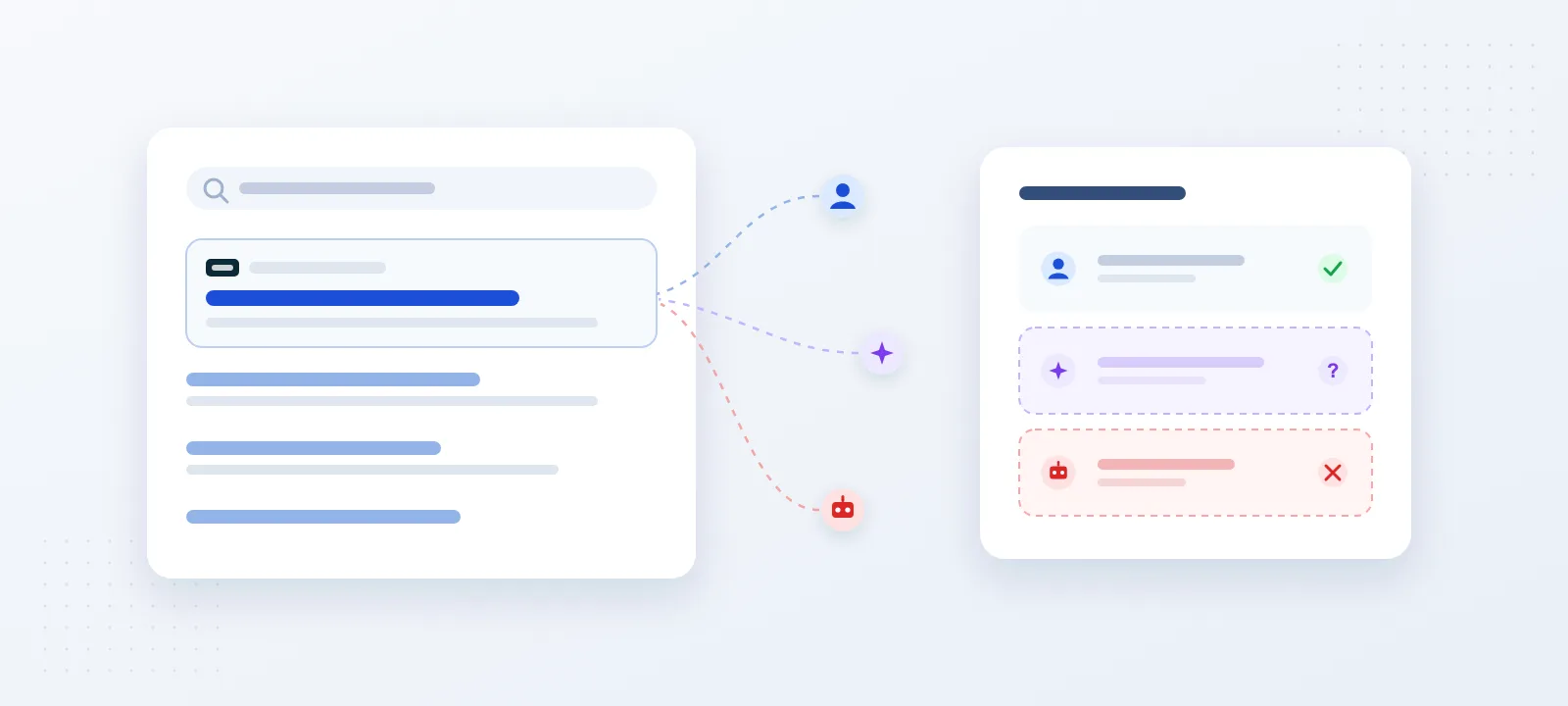
AI agents may click your ads, although nobody yet knows how frequently. When an agent searches the web on a person's behalf, it sees sponsored results in the same way that person would, and some tasks prompt it to click one. Google, Meta and industry bodies have not stated whether those clicks are invalid traffic. Today, you can distinguish between types of AI traffic, see whether they reach your site, and ensure that conversions count only real visitors.
This guide explains the three types of AI traffic, the available information on agents and ads, and the checks to make in your own account. It separates published facts from vendor opinion, as there is much more vendor opinion on this subject.
Three kinds of AI traffic
| Kind | What it does | How to recognise it |
|---|---|---|
| AI crawlers | Retrieve pages to train models or answer questions, such as GPTBot or PerplexityBot | They identify themselves in the user agent. Many retrieve pages without running your analytics script, which means they rarely show up in GA4 |
| Declared agents | Identify themselves while browsing and acting for a person, for example ChatGPT's cloud browser | OpenAI uses Web Bot Auth to sign these requests. It is based on the HTTP Message Signatures standard (RFC 9421), with Signature-Agent set to "https://chatgpt.com". Cloudflare and Akamai recognise it |
| Undeclared agentic browsers | Operate in an ordinary browser and behave like a visitor | The browser alone makes them hard to distinguish from a person |
For click fraud, the second and third types matter most. They open search results and may click an ad.
Do AI agents click ads?
Yes, they can. An agent told to find a plumber or compare software searches and reads the results, including sponsored results. Whether it clicks an ad depends on both the task and the agent. We found no published measurement of how often this occurs in Google Ads.
The official position remains open. Google's invalid clicks help page includes automated traffic: "Clicks from automated tools, bots, or other deceptive software." It does not refer to AI agents (checked 26 November 2026). In November 2026, vendor Spider AF said it found "no official position from Google, Meta, or industry groups" on agent clicks.
Is an AI agent click fraud?
Not always, and that is the difficult part. An agent may act on a real person's genuine interest: a person asks it to find a supplier, and the click reflects that intent. In May 2026, writing for the Brand Safety Institute, Dave Byrne described these as "intent-bearing non-humans" and argued that they are "indistinguishable from sophisticated invalid traffic" from a fraud detector's perspective.
A bot farm using AI to copy human visitors is different. That is click fraud using better tools, and it is what costs advertisers money. The useful test is the result: does the visit produce a real enquiry, sign-up or sale, or merely a billed click?
What research says about detecting agents
In May 2026, Ethan Wang, Zubair Shafiq and Yash Vekaria published an arXiv study comparing seven AI browsing agents with human users. Browser fingerprints were poor at separating agents when multiple agents shared them. Behavioural fingerprints, by contrast, were "distinctive". In their case study, the method identified all seven agents, while Cloudflare identified one. For advertisers, this means device and IP checks alone miss agents. On-page behaviour reveals more.
What to check in your own account
- Review your invalid click rate. If it rises in one campaign, Google is filtering more automated clicks in that campaign. What is a normal invalid click rate shows you how to interpret it.
- Review your server or CDN logs. Signed agent traffic includes the Signature-Agent header. Cloudflare lists it in its bot directory as chatgpt-agent.
- Monitor direct and unassigned traffic in GA4. Sessions from undeclared agents may arrive with no clear source and show little engagement.
- Count only verified visits as conversions. When an agent submits a form, it creates a conversion that Smart Bidding learns from. See how to stop fake leads from Google Ads.
- Do not automatically block agents. A declared agent might be acting for a real customer. Measure first, then make a decision for each source.
What a click fraud tool adds
A click fraud tool assesses how every paid visit behaves, which research found to be where agents are easiest to identify. ClickPatrol scores each paid click using more than 800 data points, covering device, network and behaviour. It excludes IP addresses from invalid sources in Google Ads and can count a conversion only if the visit was scored as real. Bot traffic explains how this works across your ad platforms.
Sources
- OpenAI Help Center: cloud browser allowlisting (Web Bot Auth and the Signature-Agent header), accessed 26 November 2026.
- Google Ads Help: Invalid clicks: Definition, accessed 26 November 2026.
- Ethan Wang, Zubair Shafiq and Yash Vekaria: FP-Agent: Fingerprinting AI Browsing Agents, arXiv, 2 May 2026.
- Dave Byrne: When Bots are Us: What Agentic Traffic Means for Advertisers, Brand Safety Institute, 27 May 2026.
- Spider AF: Are AI Agents Clicking Your Ads?, updated 20 November 2026 (vendor article).
- Cloudflare Radar: ChatGPT agent in the bot directory.