Tier 2 countries are markets with moderate purchasing power, growing internet adoption, and lower advertising costs than Tier 1 markets such as the USA or UK. They sit between high-cost mature economies and low-cost Tier 3 regions. Advertisers target them for scale at lower CPC with rising digital demand.
-
Solutions
-
 Click Fraud Protection
Block invalid clicks across every ad channel.
-
 Smart Bidding Protection
Feed Google clean, human-only signals.
-
 Clean Remarketing Audiences
Exclude suspicious traffic from your lists.
-
 All Features
Every ClickPatrol feature in one place.
-
 E-commerce & Retail
Protect shopping campaigns and product feeds.
-
 Service Providers
Stop wasted spend on local & lead-gen ads.
-
 Marketing Agencies
Classify, protect and train every client account.
-
 All Industries
Browse click fraud protection by industry.
-
 Small Business
Affordable protection that pays for itself.
-
 Enterprises
Scale protection across brands & accounts.
-
 Regional Companies
Keep local budgets on real, nearby buyers.
-
 Multinationals
Consistent protection across every market.
-
-
Agencies
-
For Agencies
Classify, protect and train every client account.
-
 Partner Program
Earn 15 to 25% recurring commission on linked clients.
-
 Case Studies
21 UK agencies unlocked over 6% media savings.
-
-
Resources
-
What is Click Fraud?
Learn what fake PPC clicks are and why they matter.
-
 Bot Traffic
Detect and block non-human clicks.
-
 Competitor Fraud
Stop rivals draining your budget.
-
 Sophisticated Fraud
Catch SIVT that native filters miss.
-
 Click Farms
Stop coordinated low-quality click operations.
-
 Invalid Traffic
Block every click that never converts.
-
 Help docs
How to connect Google Ads, GTM and other ad channels.
-
 FAQ
FAQ
Answers to the most common questions.
-
 Blog
Blog
Articles and guides from our expert team.
-
 Comparisons
ClickPatrol vs ClickCease and other tools.
-
 Tools
Tools
Free tools by ClickPatrol & Friends.
-
 About ClickPatrol™
Who we are and our mission.
-
Case Studies
Why agencies and businesses use ClickPatrol.
-
 Customer Reviews
Reviews and success stories from customers.
-
Partner Program
Join our affiliate & partner program.
-
 Contact us
Talk to our team about your ad traffic.
-
- Pricing
Tier 2 countries in PPC: Why advertisers are shifting budget beyond tier 1 markets
Tier 2 countries are amongst the most undervalued in terms of paid advertising potential; however, they represent an increasing share of global internet traffic and online ad expenditure.
Companies that overlook such markets in favour of tier 1 countries are likely missing out on considerable profits.
Considering that the digital ad spend exceeded $740 billion in 2025, companies cannot afford not to understand how countries are tiered and how to target them effectively.
In this article, we'll look at what tier 2 countries are, how they differ from tier 1 and tier 3 countries, how to run campaigns successfully in them, and how to measure their effectiveness.
What are tier 2 countries?
In digital and affiliate marketing, countries are generally classified into three tiers based on the quality of their traffic, purchasing power, conversion rates, and advertising costs.
Tier 2 countries sit in the middle of that hierarchy: they have moderate internet access, rising middle classes, and growing demand for online goods and services, but without the high CPC levels and competitive pressures seen in tier 1 countries like the United States, the UK, Canada, and Australia.
How are countries classified into PPC tiers?
Countries are not officially assigned to tier 1, tier 2, or tier 3 by any governing body. The classification is an industry convention widely used in PPC advertising, affiliate marketing, and programmatic media buying.
Advertisers and agencies group countries into tiers based on performance and market signals, such as purchasing power, advertising costs, and user behaviour.
These groupings help marketers estimate expected returns before running campaigns in a new region. The most common factors used to determine tiers include GDP per capita, purchasing power, internet penetration, average cost per click (CPC), conversion rates, and the level of advertiser competition in that market.
Countries with high income levels and high competition usually fall into tier 1, while emerging but fast-growing markets are classified as tier 2.
How are countries classified into PPC tiers?
There is no single official body that assigns tier classifications. The framework is an industry convention used across PPC, affiliate marketing, and programmatic advertising.
Countries are typically grouped based on a combination of factors:
- GDP per capita and purchasing power: higher-income populations tend to convert at higher values, driving advertiser demand.
- Internet penetration: the share of the population with reliable online access.
- Average CPC: how much advertisers collectively bid for clicks in a given market.
- Conversion rates: how frequently traffic in a country results in meaningful actions.
- Advertiser competition: how saturated the market is with competing campaigns.
Example of how tier 1, tier 2, and tier 3 countries compare in PPC
To understand how these tiers differ in practice, here is a simplified comparison based on typical advertising conditions across each group.
| Feature | Tier 1 | Tier 2 | Tier 3 |
| Examples | USA, UK, Australia, Canada | Brazil, India, Poland, Mexico | Bangladesh, Nepal, parts of Sub-Saharan Africa |
| Average CPC | High | Moderate | Very low |
| Purchasing power | High | Growing | Low |
| Internal penetration | Very high | Moderate to high | Low to moderate |
| Competition level | Very high | Moderate | Low |
| Conversion rate | High | Moderate | Low |
| Traffic volume | High | Very high | Variable |
| Ad fraud risk | Lower | Moderate | Higher |
Common tier 2 countries for PPC advertising
Tier 2 countries are not fixed, but the following markets are widely recognised in PPC and affiliate advertising as tier 2 due to their balance of growing digital adoption and moderate advertising costs:
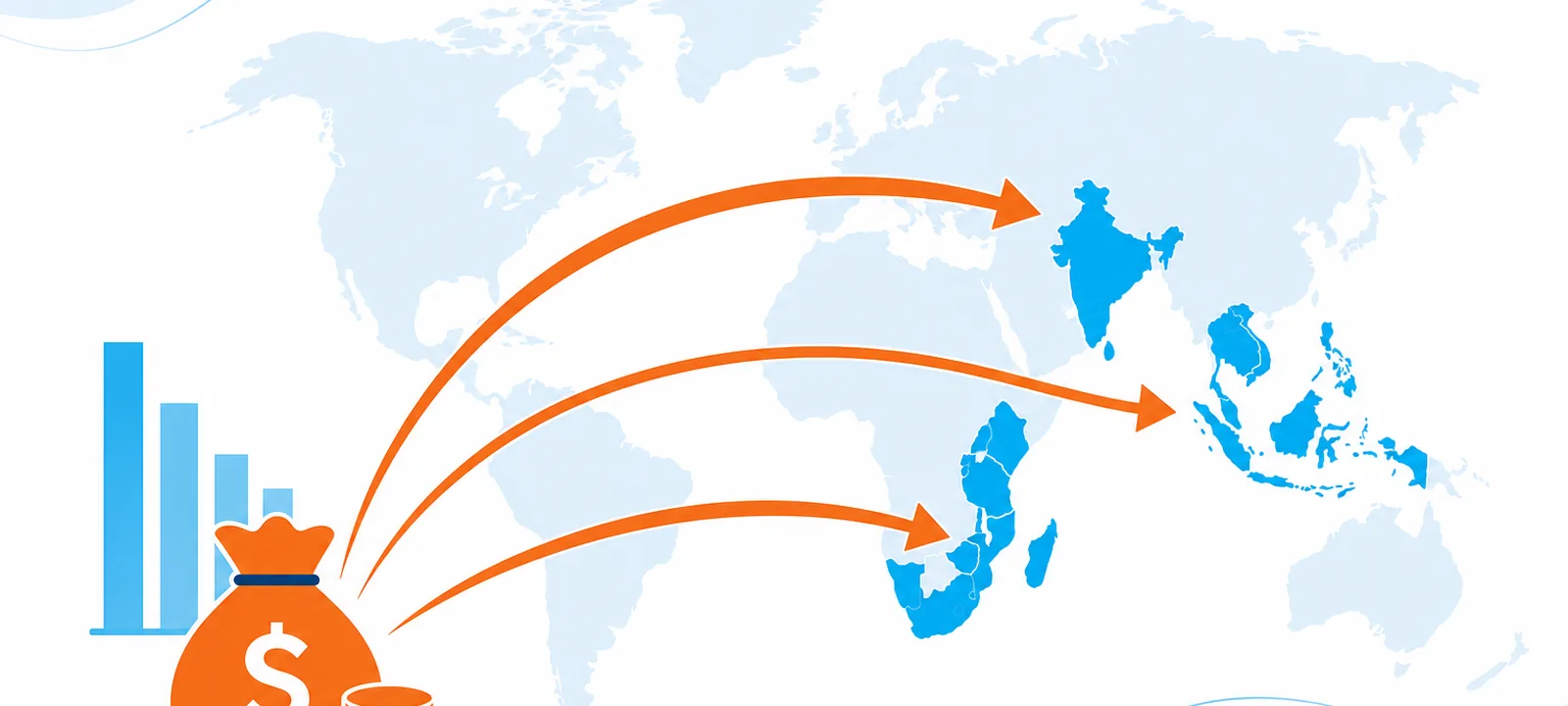
Brazil, Mexico, Argentina, Chile, Colombia, Poland, Romania, Turkey, Czech Republic, Hungary, India, Malaysia, Thailand, Philippines, Indonesia, Vietnam, South Africa, Egypt, Nigeria, Ukraine, and Saudi Arabia.
These countries often sit between high-cost Tier 1 markets and low-cost Tier 3 markets, making them attractive for advertisers seeking scale without extreme CPC pressure.
Why are tier 2 countries attracting more advertiser attention?
More advertisers are moving into tier 2 markets for a few clear reasons.
- Rising digital use: More people in these countries now use smartphones and the internet daily, which makes online ads more effective than before.
- Lower costs: Clicks in places like Brazil and Poland are often much cheaper than in the US, sometimes by up to 70%, giving better returns for the same budget.
- High competition in tier 1: Tier 1 markets are crowded and expensive. Tier 2 markets offer lower competition and more room to grow.
How much PPC budget should you allocate to tier 2 countries?
There is no fixed budget split, but advertisers typically start cautiously and scale based on performance.
During the testing phase, many advertisers allocate 10–20% of their total PPC budget to tier-2 markets.
This allows enough data collection without overspending. In the scaling phase, successful campaigns often expand tier 2 allocation to 20–40%, especially when conversion rates and cost per acquisition remain stable or improve compared to tier 1 markets.
For mature campaigns, budget distribution depends entirely on profitability. Some advertisers eventually shift the majority of their spend to tier 2 markets when returns there outperform those in tier 1 regions.
How to advertise successfully in tier 2 countries
Tier 2 markets require more than lowering bids on a tier 1 strategy. You need structural and creative adjustments.
Geo-targeting and bids
Use country-level bid adjustments to control spend across regions. Start with conservative bids in tier 2 markets and scale based on performance. Separate very different countries, as results can vary widely.
Localization beyond translation
Localization is more than language. It involves adapting currency, cultural references, tone, visuals, and user pain points.
A translated ad alone can still underperform if it is not culturally aligned with how people think and make decisions in that market.
For example, a US ad saying “Fast business loans in minutes” may not resonate as strongly in Mexico as “Quick financing to grow your small business today.”
Both communicate speed and access to funding, but the second is more context-aware and speaks to small business growth, which is a stronger emotional trigger in that market.
Landing page alignment
Match your landing page to user expectations. Many tier 2 markets are mobile-first and have slower internet, so lightweight, fast-loading pages perform better.
Payment and trust signals
Improve conversions by adding local payment options, security badges, and familiar social proof to build trust.
What industries perform best in tier 2 countries?
Not all products translate equally well across markets, but some industries consistently perform well in tier 2 regions.
- E-commerce and retail: Online shopping is growing rapidly in markets such as Brazil, India, and Southeast Asia, supported by greater smartphone adoption and improved payment systems.
- Mobile apps and gaming: Tier 2 users are highly mobile-first, driving strong demand for apps, games, and streaming. Mobile gaming in Southeast Asia alone is worth billions and continues to grow quickly.
- Fintech: Digital payments, microloans, and insurance apps perform well, especially in markets with large unbanked populations, such as Mexico, Nigeria, and the Philippines.
- Edtech: Online learning platforms are expanding across regions such as South Asia, Latin America, and Eastern Europe due to rising internet access and demand for skills-based education.
- Travel and hospitality: Outbound travel from countries like Brazil and Poland is increasing, making travel-related ads more relevant and competitive in these markets.
How do you measure success in tier 2 campaigns?
For Tier 2 country campaigns, the metrics you track should go beyond clicks and focus on profitability and traffic quality.
Treating each country as its own data set and lumping all Tier 2 markets together hides meaningful differences in performance.
Key metrics to track
- Conversion Rate (CVR): How many visitors complete a desired action after clicking your ad. It shows whether your offer and landing page work for local audiences.
- Cost Per Acquisition (CPA): How much you spend to get a lead or sale. In tier 2 markets, this should usually be lower, but it must remain profitable as you scale.
- Return on Ad Spend (ROAS): How much revenue you earn for every dollar spent. Even with low CPA, campaigns can fail if customer value is low.
- Click-Through Rate (CTR): Shows how well your ads attract attention. High CTR indicates strong relevance, but it must be matched by actual conversions.
- Cost Per Click (CPC): Track CPC by country and device. Costs can rise quickly as competition increases in tier 2 markets.
- Lead and sales quality: Not all conversions are equal. Monitor how many leads become real customers and how many stay or are refunded.
- Invalid traffic rate: Watch for bot clicks, unusual patterns, and suspicious traffic, especially in new markets. Engagement metrics: For content or lead campaigns, track bounce rate, time on page, and scroll depth.
- Customer lifetime value (LTV): Important for subscription-based or repeat-purchase models. Some markets may have fewer buyers but higher long-term value.
Is ad fraud a concern in tier 2 countries?
Yes, but it is manageable. Ad fraud is not limited to any one tier and exists in tier 1 markets as well. However, tier 2 and tier 3 countries can carry a higher risk due to weaker regulation, more bot-heavy traffic in some regions, and lower advertiser scrutiny.
Click fraud is widely recognized as a persistent issue in pay-per-click advertising, with rates varying significantly by industry, traffic source, and geography.
The solution is not to avoid tier 2 markets, but to track traffic properly. Using fraud detection tools before scaling helps ensure your budget goes toward real users and accurate performance data.
Are tier 2 countries worth it for small advertisers?
Tier 2 countries can be highly worthwhile for small advertisers, but success requires realistic expectations and a methodical approach.
- Advantages: lower CPCs and CPAs than Tier 1 markets; less competition, especially in emerging verticals; more room to test and learn on a smaller budget; and the opportunity to build brand presence before markets become saturated.
- Disadvantages: lower purchasing power can mean smaller average order values; traffic quality requires closer monitoring; localization requires additional creative and operational investment; and some markets carry a higher baseline fraud risk.
- When small advertisers should be cautious: if your product is exclusively relevant to high-income audiences, if you lack the bandwidth to localise properly, or if your margins are too thin to absorb the cost of fraud monitoring.
Why tier 2 countries deserve a permanent place in your ad strategy
Tier 2 countries are not just a way to cut costs. They are a real growth channel with large audiences, lower competition, and strong conversion potential when managed well.
Success still depends on the basics: accurate targeting, localized creatives, proper measurement, and protection against invalid traffic.
As competition intensifies in tier 1 markets and advertising costs rise globally, tier 2 countries are becoming a core part of sustainable PPC growth strategies.
Advertisers who learn to test, localise, and optimize in these markets early are more likely to maintain stronger margins and achieve long-term scalability than those who rely solely on saturated Tier 1 regions.
Frequently Asked Questions
What are Tier 2 countries in advertising?
Which countries are considered Tier 2?
There is no official universal list. Marketers commonly include Brazil, Mexico, Poland, Romania, Turkey, Malaysia, Thailand, the Philippines, South Africa, India, Indonesia, Vietnam, and Chile among Tier 2 markets. Classifications shift as local economies and ad competition evolve, so treat lists as guides.
Are Tier 2 countries cheaper for PPC?
Yes, typically. Tier 2 Google Ads markets often show CPC 40 to 70 percent lower than Tier 1 countries in the same vertical, though gaps vary by industry. Lower CPC does not guarantee lower cost per acquisition; conversion rates and payment friction still determine whether campaigns profit.
What is the best Tier 2 country for Google Ads?
No single country wins for every product. Brazil and India offer large traffic pools; Poland and Romania often perform well for SaaS and e-commerce; Mexico suits US-adjacent offers with Spanish localization. Test one or two markets with localized creatives before scaling spend across the whole tier.
Can small businesses succeed in Tier 2 PPC?
Yes. Lower CPC and lighter competition help small budgets gather data faster than in saturated Tier 1 auctions. Success requires localized landing pages beyond translation, clear payment and shipping options, and tight tracking of CPA and ROAS from day one. Scale only markets that hit margin targets.
Is click fraud higher in Tier 2 countries?
Some Tier 2 and Tier 3 markets show higher invalid traffic on certain channels, but fraud exists in every region. Monitor placement and search partner reports, compare analytics sessions to clicks, and use verification tools rather than avoiding whole countries. Proper setup matters more than geography alone.

Written & reviewed by
Abisola Tanzako
Content Manager, ClickPatrol (click fraud & invalid-traffic specialist)
Abisola covers bot traffic, ad fraud and PPC protection, drawing on ClickPatrol platform data from 1,793+ businesses.
Last updated: 6 October 2026