
 English
 Nederlands
Product views and add-to-carts with no orders behind them
A run of ViewContent or AddToCart events from Instagram that never reaches checkout is worth holding up against how ClickPatrol labelled those visits.
ClickPatrol labels each visit from your Instagram ads as legitimate or suspicious. Point your Meta Pixel at the legitimate label, and retargeting, lookalikes and your purchase signal start from real shoppers.
Done. We are opening your account.
Sent. Look in your inbox and create your account whenever it suits you.
 4.9
 4.5
Google Certified Click Tracker
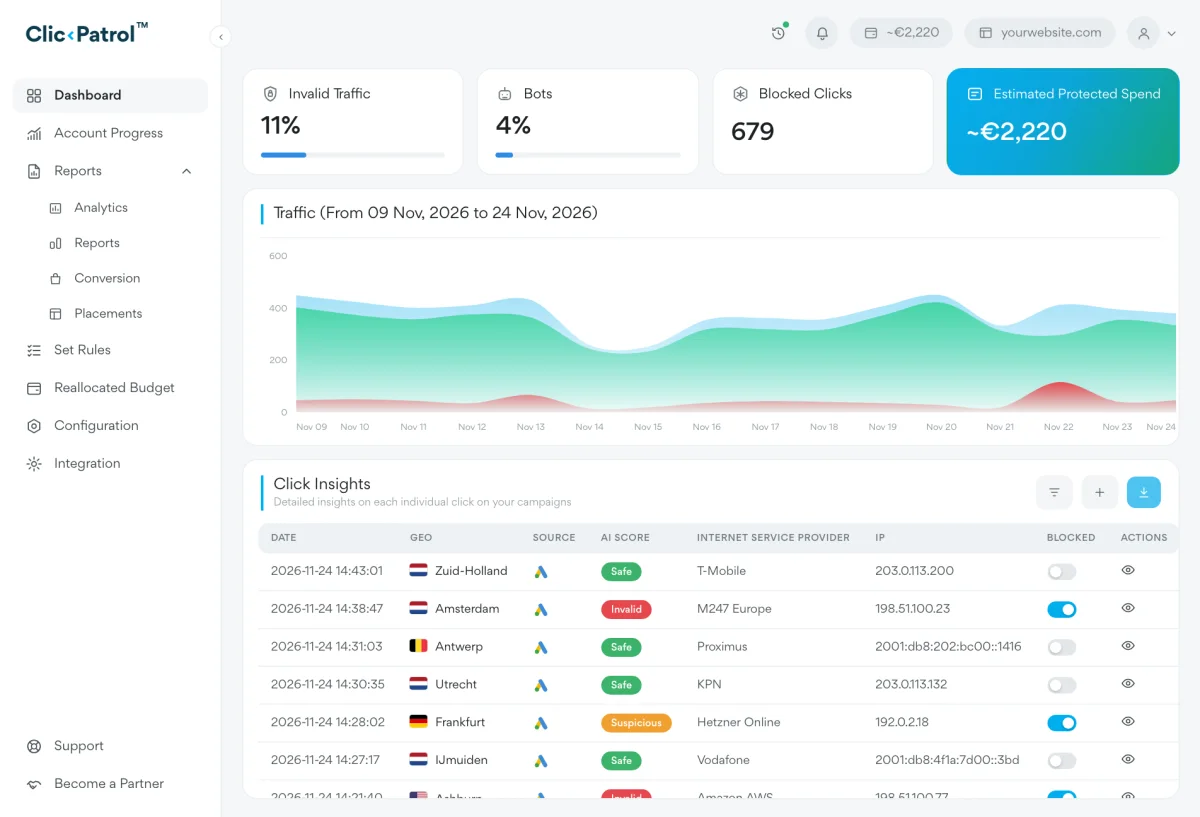
On Instagram, ClickPatrol works through your Meta Pixel: it fires only on shop visits labelled legitimate, and the suspicious ones become an audience you keep out of prospecting.
How it works
Campaigns, catalogue and creatives are untouched. What changes is which visits reach the Meta Pixel.
1Label
The UTM template on your Instagram ads marks the visit as Meta traffic and records the placement it came through. The ClickPatrol tag weighs device, network and behaviour, then pushes ClickPatrol_Legitimate or ClickPatrol_Suspicious into Google Tag Manager. Later pages in the same visit get the same label.
2Gate
In Google Tag Manager, swap the All Pages trigger on your pixel for a Custom Event trigger on ClickPatrol_Legitimate. From then on a suspicious visit never reaches Meta, so it cannot join a website audience or a lookalike seed. Step by step: clean traffic pixel trigger.
3Build
Combine CP Legitimate 30d with what shoppers did, for example viewed a product but did not buy, and retarget that. Seed lookalikes on buyers whose visit was labelled legitimate, and exclude CP Suspicious 30d from prospecting. The same idea for every channel: clean remarketing audiences.
After the tap
The click is paid once. What it leaves in your pixel keeps shaping who sees your ads next.
A run of ViewContent or AddToCart events from Instagram that never reaches checkout is worth holding up against how ClickPatrol labelled those visits.
Lookalikes start from a seed list. If bot visits fired the events you seed on, Meta goes looking for more profiles like them. Seeding on buyers from legitimate visits takes that out.
When suspicious visits fire the pixel, they sit inside your Instagram results in Ads Manager. Gate the events you optimise on, and from your ads Events Manager only counts the visits that passed.
Get started
Your shop needs Google Tag Manager, and the Meta Pixel should run inside it. On Shopify that means GTM in your theme.
Enter your work email and pass the €0.01 verification. The trial measures; nothing in your ads changes.
Fire the ClickPatrol tag on All Pages in GTM and add the UTM template to URL parameters on each Instagram ad.
Move your pixel, or the events you optimise on, to the ClickPatrol_Legitimate trigger, then create your audiences.
Reviews
4.974 reviews 5.018 reviews
 5.051 reviews4.523 reviews
“I manage ads for an e-commerce brand, and we were seeing strange spikes in clicks with zero conversions. After starting with ClickPatrol, the difference was immediate. Within two weeks, our ROAS improved and the fake traffic disappeared. The price easily pays for itself.”
“ClickPatrol helped me detect over 20% invalid traffic in the first week. Their algorithm works perfectly, and the reporting dashboard gives me complete visibility. The tool is reliable, affordable, and essential for protecting ad investments. I’ll definitely continue using it long-term.”
“We were skeptical at first because we thought Google already filters out invalid clicks. Turns out they miss a LOT. ClickPatrol showed us exactly what was slipping through. After 3 months of use our lead quality is way up and we're spending less to get the same results. Can't imagine running ads without it now.”
Read at the source on 16 November 2026 for G2, 4 November 2026 for Capterra and SourceForge, and 11 August 2026 for Trustpilot. Read all customer reviews
Questions
On your storefront, yes: home, product, collection and cart pages load your GTM container, so Instagram visits get labelled there. Checkout does not load your theme, and purchase events sent by Shopify's Meta app run outside GTM, so those are not gated. Gate the storefront events, and keep in mind what the app still sends.
If you gate the whole pixel, yes, because ClickPatrol only labels ad traffic. You can keep a base pixel firing on all pages and gate only the events you build audiences or optimise on, such as AddToCart or Purchase. Organic tracking stays, and the ad-driven signals are cleaned.
No. ClickPatrol labels visits on your website, through its tag in Google Tag Manager. A tap that ends on a profile, a follow or a direct message never loads your site, so there is nothing to label. Ads with a website destination and the UTM template are the ones that get scored.
That purchase is not tied to the label. The classification sits in a first-party cookie for 24 hours, in one browser. Someone who switches device, or comes back after a day without clicking an ad, arrives as a new visit. Your normal purchase event still counts them, which is why you keep it.
The seed shrinks, because suspicious visits drop out of it. Keep it at 1,000 people or more, ideally 5,000, with a rolling window so it refreshes. Then compare the cost per purchase of lookalikes on the clean seed with your old one. That comparison is the quickest proof, whichever way it goes.
Instagram campaigns usually share an ad account with Facebook. How Facebook clicks are scored.
How it works on FacebookShort-video campaigns on TikTok: how flagged visitors stay out of your TikTok audiences.
How it works on TikTokReaching a young audience on Snapchat as well? How it works there.
How it works on SnapchatTag your Instagram ads, keep them running as they are, and check what share of those visits gets the suspicious label before you touch the pixel. Cancel within 7 days and the €0.01 verification is all you paid.
Done. We are opening your account.
Sent. Look in your inbox and create your account whenever it suits you.