A competitor repeatedly clicking your search ads to drain the daily budget is one. Others include bots filling in lead forms, click farms generating paid clicks that never convert, and affiliates using cookie stuffing to claim commission on sales they did not create.
-
Solutions
-
 Click Fraud Protection
Block invalid clicks across every ad channel.
-
 Smart Bidding Protection
Feed Google clean, human-only signals.
-
 Clean Remarketing Audiences
Exclude suspicious traffic from your lists.
-
 All Features
Every ClickPatrol feature in one place.
-
 E-commerce & Retail
Protect shopping campaigns and product feeds.
-
 Service Providers
Stop wasted spend on local & lead-gen ads.
-
 Marketing Agencies
Classify, protect and train every client account.
-
 All Industries
Browse click fraud protection by industry.
-
 Small Business
Affordable protection that pays for itself.
-
 Enterprises
Scale protection across brands & accounts.
-
 Regional Companies
Keep local budgets on real, nearby buyers.
-
 Multinationals
Consistent protection across every market.
-
-
Agencies
-
For Agencies
Classify, protect and train every client account.
-
 Partner Program
Earn 15 to 25% recurring commission on linked clients.
-
 Case Studies
21 UK agencies unlocked over 6% media savings.
-
-
Resources
-
What is Click Fraud?
Learn what fake PPC clicks are and why they matter.
-
 Bot Traffic
Detect and block non-human clicks.
-
 Competitor Fraud
Stop rivals draining your budget.
-
 Sophisticated Fraud
Catch SIVT that native filters miss.
-
 Click Farms
Stop coordinated low-quality click operations.
-
 Invalid Traffic
Block every click that never converts.
-
 Help docs
How to connect Google Ads, GTM and other ad channels.
-
 FAQ
FAQ
Answers to the most common questions.
-
 Blog
Blog
Articles and guides from our expert team.
-
 Comparisons
ClickPatrol vs ClickCease and other tools.
-
 Tools
Tools
Free tools by ClickPatrol & Friends.
-
 About ClickPatrol™
Who we are and our mission.
-
Case Studies
Why agencies and businesses use ClickPatrol.
-
 Customer Reviews
Reviews and success stories from customers.
-
Partner Program
Join our affiliate & partner program.
-
 Contact us
Talk to our team about your ad traffic.
-
- Pricing
Anura Alternatives: 7 Ad Fraud Tools
Last updated: August 2026
Anura is a detection engine rather than a blocker. Its own FAQ states the software does not stop bad traffic; blocking needs the Search and Social Protect add-on. Pricing is quote only. The best Anura alternatives, ClickPatrol, TrafficGuard, ClickCease, Fraud Blocker, ClickGuard, Clixtell and Hitprobe, all publish a price and block inside the ad platform.
What Anura is built to do
Anura answers one question about every visitor: real person or not. It has been doing that since 2015, benchmarked against validated conversion data going back to 2005, and it claims over two million domains. The company sells mainly to lead generation firms, affiliate marketers, ad networks, call centres and programmatic buyers, which is a different crowd from the small business running two Google Ads campaigns.
The verdict engine, and what it is good at
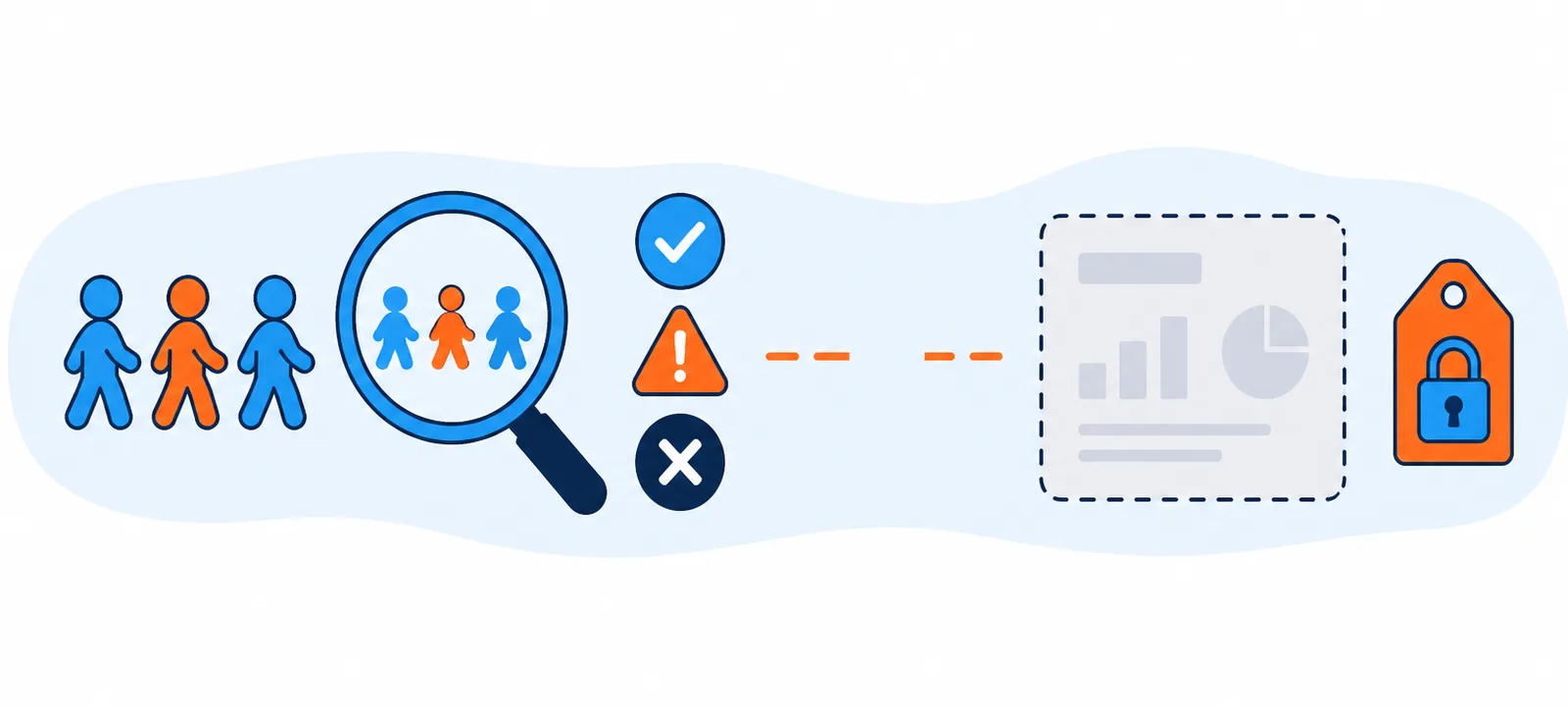
You install either Anura Script, a JavaScript tag, or Anura Direct, a server-to-server REST API. Each request comes back with a plain answer. Script returns Good, Warning or Bad. Direct returns SUSPECT or NONSUSPECT. There is no risk score, which the company treats as a point of principle: it calls numerical scoring a vanity metric and argues that a percentage leaves you guessing where to draw the line.
The accuracy claim is narrow and, read carefully, quite strong. Anura guarantees 99.999% accuracy when it marks a visitor as bad, and says a Bad answer means it is certain the visitor is not real. That is a false-positive guarantee, not a promise to catch everything. The Warning band exists precisely to absorb the borderline cases that the company says produce false positives at other vendors. For a lead generation business paying for every lead it passes to a buyer, that distinction is worth real money.
The blocking question, which Anura answers twice
Here the site contradicts itself, and anyone evaluating Anura should see both statements. The FAQ is blunt: "Anura does not stop bad traffic", and on whether it can actively block, "Our software doesn't block visitors in any way. We give you the answer in real-time so that you can handle the visitor in any fashion you'd like." A popular customer approach, per the same page, is redirecting flagged visitors to a 404.
The Search and Social Protect page says something else. There, Anura automatically hides your ads from visitors it has marked fraudulent on Google, Microsoft Ads, Facebook, Instagram, TikTok, X, YouTube and LinkedIn, and argues this removes any need to chase refunds.
Both are true of different parts of the product. The core engine reports; the add-on acts. What matters when you compare quotes is which one you are actually being sold, because the engine on its own leaves you to build the response yourself.
Where an Anura evaluation usually stalls
Three things send people looking at other options.
The first is price. Anura publishes nothing. The FAQ says the product is priced on usage and points you at the sales team, and there is no pricing page in the site navigation at all. You cannot compare it against anything without booking a call first, and for a business weighing a $50 monthly tool against an enterprise contract, that alone ends the evaluation.
The second is the work after the verdict. A tag or an API that returns Good, Warning or Bad is only useful once something consumes that answer. You pass SOURCE and CAMPAIGN variables correctly, you read the dashboard, you decide which traffic sources to cut, and you build whatever redirects or exclusions your protocol calls for. That suits a team with engineers and a media buying operation. It suits a marketing manager with a Google Ads account far less.
The third is fit. Anura is built around traffic sources: which publisher, affiliate or partner is sending you rubbish, so you can stop buying from them. If your problem is instead that competitors and bots are clicking your search ads and your junk leads are coming straight from paid search, you want a tool that sits on the ad account and excludes the offender, not one that grades your supply chain.
Seven alternatives, and what each one replaces
Every price below is the vendor's own published list price, checked in August 2026. Where a vendor publishes nothing, that is stated rather than estimated.
ClickPatrol
Built for the case Anura handles least directly: paid search and social accounts where the fix is an exclusion inside the ad platform. ClickPatrol scores each click on more than 800 data points, blocks the source automatically at a stated 99.97% bot accuracy, and connects to Google Ads in about a minute with no code. For lead generation specifically, FormProtector filters spam and low-value form fills before they land in a CRM, and DataProtector keeps those junk conversions out of the signal Smart Bidding trains on.
Plans are public and start at €59 a month for Traffic Security Starter on annual billing, covering unlimited domains and unlimited platforms, with Google Ads, Meta, Microsoft Ads and DV360 included and Performance Max supported. The free Traffic Insights tier watches without blocking, so protection needs a paid plan. The trial runs 7 days and asks for a card only to verify identity with a one-time €0.01 charge. Details sit on the click fraud protection pricing page, and the lead generation page covers the cost-per-real-lead angle. Dutch-built, GDPR and CCPA compliant, Google-certified click tracker, 1,793+ businesses.
TrafficGuard
The closest match to Anura's breadth. Beyond search, it sells separate enterprise products for affiliate and mobile app traffic, including conversion-level attribution control, cookie stuffing and forced click prevention, install verification and post-attribution validation through MMP integrations. If you came to Anura because of affiliate payout fraud rather than click fraud, this is the one to look at.
It also shares Anura's habit of quoting rather than publishing, but only above a line. Shield is $49 a month for one domain on Google Search up to $30,000 of monthly spend, with a 30-day trial that runs in detection mode. Everything else, Meta included, is a custom quote on the Scale plan. More in our TrafficGuard review.
ClickCease
The SMB tier of CHEQ, and the option with the largest install base. It blocks fraudulent IPs on Google, Meta and Microsoft Ads automatically, adds WordPress bot protection, and validates HubSpot leads through Lead Shield, which is the feature lead generation teams tend to care about. Agency permissions and white-label reporting start on Pro.
Pricing runs from $99 a month billed annually to $349 for Advanced. The advertised discount only covers three billing cycles. Check the allowance definition too: CHEQ counts any activity it detects, including internal page views, rather than ad clicks alone. Our ClickCease review has the detail.
Fraud Blocker
A pragmatic middle option. $79 a month covers 5,000 ad clicks and one site, and $99 stretches to 25,000 clicks across 50 websites with ten team members. Annual billing takes 20 percent off. Detection includes fraud scoring, device fingerprinting, VPN and proxy blocking and custom rules, with API access and a white-label platform on every tier.
It also sells an email spam protection add-on that verifies form submissions, which overlaps with the lead quality job people hire Anura for. Two caveats: Microsoft Ads is not native, so IP lists get exported to CSV and imported manually, and protection stops once the monthly click allowance is used up.
ClickGuard
Charges on monthly ad spend instead of clicks, with unlimited clicks on every plan. That is the right shape for accounts pushing large volumes of cheap traffic, which is common in lead generation. Exclusion control is the deepest in this group: cross-account, geo, multi-targeting, VPN, IP range, non-human, behaviour and conversion based.
Lite starts at $74 a month but covers a single website and only one of Google, Meta or Microsoft. Standard from $119 covers all three and Pro from $159 adds conversion tracking and six months of data retention. On Lite that retention window is one month, which is thin if you need to reconstruct what happened in a bad quarter. See our ClickGuard review.
Clixtell
Relevant here because of Anura's call-centre clients. Clixtell bundles click fraud work with session video recording and conversion tracking from the entry tier, and $15 a month buys detection for 5,000 ad clicks. Actual blocking, meaning automatic Google Ads IP exclusions plus custom rules and Account Defense Mode, starts at $50. Agency from $75 covers unlimited domains and Google Ads accounts with native MCC support.
It is the cheapest genuine entry point in the category, with the narrowest reach: Google plus Bing per the vendor FAQ, and no documented Meta protection. Plans are per domain below the Agency tier. Our Clixtell review covers where its detection stops.
Hitprobe
The pick for teams that liked Anura's API-first approach but wanted a price on the website. It exposes an HTTP API, webhooks on any saved view, scheduled exports and session-level inspection with browser fingerprinting and a risk level per session, and it applies exclusions itself rather than handing you a verdict. Google, Meta and Microsoft audience exclusions are included, with other networks driven through a Google Tag Manager event.
There is a free tier at 50 sessions, useful only for testing, and real plans start at $80 a month for 10,000 sessions across five sites, up to $490 for 250,000. Every plan carries every feature. The vendor states limited Performance Max and Shopping support, so check your campaign mix.
Price transparency and reach side by side
The column that matters most on this page is the first one. Anura and, above its entry plan, TrafficGuard are the only two here that will not tell you what they cost without a conversation.
| Tool | Price published | Entry price | Blocks in the ad platform | Reach beyond Google |
|---|---|---|---|---|
| Anura | No, quote only | On request | Only with Search and Social Protect | Meta, Microsoft, TikTok, X, YouTube, LinkedIn, programmatic, mobile |
| ClickPatrol | Yes | €59/mo | Yes, on Traffic Security plans | Meta, Microsoft, DV360, social |
| TrafficGuard | Entry plan only | $49/mo | Yes, after detection mode | Meta, affiliate and mobile on quote |
| ClickCease | Yes | $99/mo | Yes | Meta, Microsoft |
| Fraud Blocker | Yes | $79/mo | Yes | Meta; Microsoft by CSV export |
| ClickGuard | Yes | $74/mo | Yes | Meta and Microsoft, one platform on Lite |
| Clixtell | Yes | $15/mo, blocking from $50 | Yes, from the $50 plan | Bing |
| Hitprobe | Yes | Free, paid from $80/mo | Yes | Meta, Microsoft, others via GTM |
Matching the tool to how you buy traffic
Anura's model assumes you buy traffic from sources you can turn off. If that describes you, the honest answer is that most of the tools above are not substitutes, and your shortlist is Anura or TrafficGuard.
If instead you buy clicks from Google and Meta directly, the question becomes who applies the exclusion. A verdict you have to act on yourself has a cost that never shows up on the invoice, measured in the hours between the flag and the fix. Any of ClickPatrol, ClickCease, Fraud Blocker, ClickGuard, Clixtell or Hitprobe closes that gap.
Then check three practical things. Whether the tool protects the platforms you actually run, since Clixtell stops at Google and Bing and TrafficGuard's cheap plan stops at Google Search. Whether it prices on clicks, visits or ad spend, because the wrong basis gets expensive quickly on high-volume, low-cost traffic. And whether the invalid traffic is kept out of your remarketing lists and conversion data, not just off the invoice, which is the part that compounds over a quarter of click fraud protection rather than a single week.
A short recommendation by scenario
Buying affiliate, programmatic or publisher traffic and grading sources: stay with Anura, or look at TrafficGuard if you want affiliate payout protection with an entry plan you can see the price of.
Running paid search and social for your own lead generation: ClickPatrol, because the exclusion happens on the ad account and the form and conversion signals get cleaned as well as the clicks.
Needing HubSpot lead validation alongside click blocking: ClickCease Pro.
Wanting Anura's API-driven approach with published pricing: Hitprobe.
Working with a small budget or a call-heavy funnel: Clixtell at $50 for blocking, or Fraud Blocker at $79 if you also want form and email verification.
High volume at low cost per click, where per-click pricing hurts: ClickGuard, priced on spend.
The rest of the category is on our alternatives hub.
Frequently Asked Questions
What is an example of ad fraud?
How much does ad fraud cost?
Estimates vary widely and every published figure comes from a vendor. Fraud Blocker cites Juniper Research at 22 percent of ad spend wasted, ClickPatrol puts up to 21 percent of PPC traffic as fraudulent, and Improvely still quotes 17 to 29 percent. Treat any single number with care.
How much does Anura cost?
Anura does not publish pricing. Its FAQ states the product is priced on usage and directs you to the sales team, and the site has no pricing page. A 15-day free trial is arranged through sales, and your data stays accessible for two weeks afterwards if you do not sign up.
Does Anura have an API?
Yes. Anura Direct is a server-to-server REST API that returns SUSPECT or NONSUSPECT per request, and Anura Script is a JavaScript tag returning Good, Warning or Bad. There is also a real-time reporting API for summarised data, plus CSV and PDF export from the dashboard.

Written & reviewed by
Abisola Tanzako
Content Manager, ClickPatrol (click fraud & invalid-traffic specialist)
Abisola covers bot traffic, ad fraud and PPC protection, drawing on ClickPatrol platform data from 1,793+ businesses.
Last updated: 6 October 2026