Yes. Broad match keywords can increase bounce rate by triggering irrelevant or loosely related search queries and bringing in users with low intent, which often leads to quick exits. Review search terms weekly and add negative keywords to filter mismatched queries.
-
Solutions
-
 Click Fraud Protection
Block invalid clicks across every ad channel.
-
 Smart Bidding Protection
Feed Google clean, human-only signals.
-
 Clean Remarketing Audiences
Exclude suspicious traffic from your lists.
-
 All Features
Every ClickPatrol feature in one place.
-
 E-commerce & Retail
Protect shopping campaigns and product feeds.
-
 Service Providers
Stop wasted spend on local & lead-gen ads.
-
 Marketing Agencies
Classify, protect and train every client account.
-
 All Industries
Browse click fraud protection by industry.
-
 Small Business
Affordable protection that pays for itself.
-
 Enterprises
Scale protection across brands & accounts.
-
 Regional Companies
Keep local budgets on real, nearby buyers.
-
 Multinationals
Consistent protection across every market.
-
-
Agencies
-
For Agencies
Classify, protect and train every client account.
-
 Partner Program
Earn 15 to 25% recurring commission on linked clients.
-
 Case Studies
21 UK agencies unlocked over 6% media savings.
-
-
Resources
-
What is Click Fraud?
Learn what fake PPC clicks are and why they matter.
-
 Bot Traffic
Detect and block non-human clicks.
-
 Competitor Fraud
Stop rivals draining your budget.
-
 Sophisticated Fraud
Catch SIVT that native filters miss.
-
 Click Farms
Stop coordinated low-quality click operations.
-
 Invalid Traffic
Block every click that never converts.
-
 Help docs
How to connect Google Ads, GTM and other ad channels.
-
 FAQ
FAQ
Answers to the most common questions.
-
 Blog
Blog
Articles and guides from our expert team.
-
 Comparisons
ClickPatrol vs ClickCease and other tools.
-
 Tools
Tools
Free tools by ClickPatrol & Friends.
-
 About ClickPatrol™
Who we are and our mission.
-
Case Studies
Why agencies and businesses use ClickPatrol.
-
 Customer Reviews
Reviews and success stories from customers.
-
Partner Program
Join our affiliate & partner program.
-
 Contact us
Talk to our team about your ad traffic.
-
- Pricing
Google Ads high bounce rate from paid traffic: causes, diagnosis, and fixes

A high bounce rate in Google Ads is one of the most common red flags advertisers see and one of the most misdiagnosed. Industry benchmarks place paid traffic bounce rates at roughly 40–50%, but the number alone doesn’t explain much.
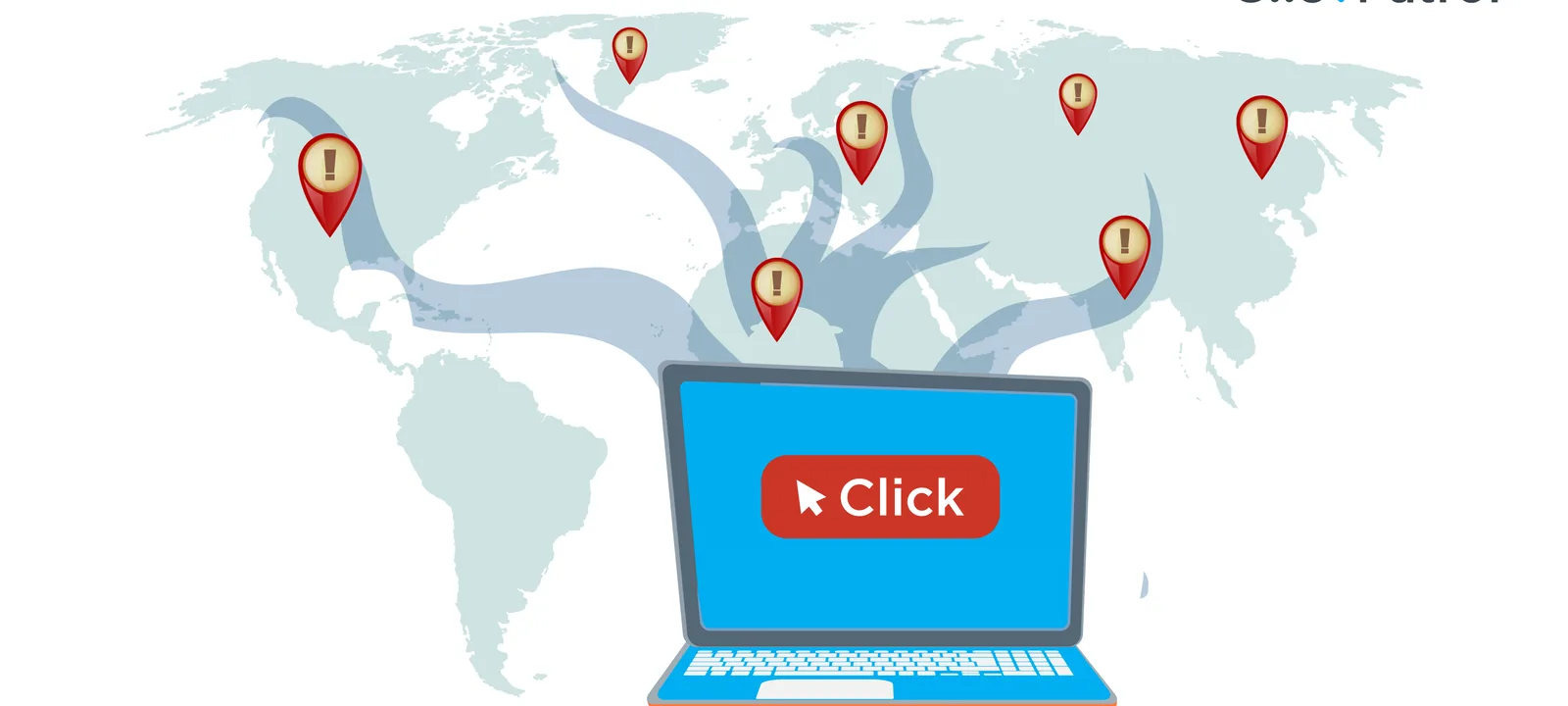
A spike can come from a broken tracking tag just as easily as a poor landing page, and the fixes are completely different. Bot traffic adds another layer: bad bots account for a large share of web traffic, and invalid clicks can distort bounce data. That’s why diagnosis matters before action.
Why does Google Ads paid traffic have a high bounce rate?
Common causes include:
- The landing page doesn’t match the ad promise
- Wrong keywords are attracting irrelevant users
- Slow mobile page speed
- Broken tracking or misfiring tags
- Overly broad audience targeting
- Bots or invalid traffic
- Search intent mismatch
The fix depends on the actual cause.
What does a high bounce rate on Google Ads mean?
A high bounce rate means a large share of people who clicked your ad left your site without taking any further action. It means users clicked your ad but left without further interaction.
In GA4, a bounce typically means:
- Session under 10 seconds
- No conversion event
- No second page view
Bounce rate doesn’t directly affect Quality Score, but it strongly relates to Landing Page Experience.
Is your bounce rate actually high, or just normal for your campaign type?
Context shapes what any given number means more than the number itself does. Rough benchmarks by campaign type:
- High-intent search: 30–55%
- Ecommerce search: 20–45%
- Display/prospecting: 60–75%
What matters most is deviation from your baseline, not generic benchmarks.
What causes Google Ads bounce rates to increase suddenly?
A sudden spike almost always traces back to one specific change: a new ad, a site or CMS update, a consent-banner deployment, a broken tracking tag, or a budget adjustment that shifted the campaign toward lower-quality traffic.
These are fast-moving causes with a clear before-and-after pattern in the data. A gradual climb over weeks is usually a different story, landing page relevance slowly eroding, invalid traffic volumes quietly growing, or audience quality drifting as Smart Bidding expands into broader, lower-intent pools.
Treating a slow drift the same way as a sudden spike leads to the wrong fix. The first question is always: when exactly did the number change, and what else changed at the same time?
Can keyword targeting cause a high bounce rate?
Yes, keyword targeting can lead to a high bounce rate when the search intent doesn’t match the landing page. If your keywords trigger irrelevant or informational searches, users may click but leave quickly.
To confirm, check your Search Terms report to see what people actually searched before clicking. If you see irrelevant queries, tighten match types, add negative keywords, or segment campaigns by intent.
Using a phrase or exact match for high-value keywords can also help improve alignment and reduce bounce rates.
Can keyword match types increase bounce rate?
Yes, keyword match types can affect bounce rate because they control how broadly your ads are shown. Broad match often brings in less relevant or informational searches, which can lead to clicks without real intent and higher bounce rates.
Phrase and exact match usually reduce this because they keep traffic more closely aligned with what the user is looking for. However, you still need negative keywords and regular search term review.
If the bounce rate is high, start by checking which match types drive traffic and whether irrelevant queries are getting through.
Does search intent mismatch cause bounces?
Yes, search intent mismatch is one of the biggest causes of high bounce rates, and it can happen even when keyword targeting is precise. The issue comes from the gap between what the user expects and what the landing page delivers.
Search intent generally falls into four types: informational, navigational, commercial, and transactional. When there is a mismatch between intent and landing page, for example, sending transactional traffic to a generic homepage or informational searches to a sales-focused page, users tend to leave quickly because the page does not match what they were looking for.
How does ad copy mismatch drive a high bounce rate?
Ad copy mismatch increases bounce rate when the ad's message doesn’t match what users see on the landing page. If users click expecting a specific offer and don’t find it immediately, they leave quickly.
For example, an ad promoting “50% off today” that leads to a standard pricing page, or a “free trial” ad that goes to a “book a demo” page, creates confusion and quick exits.
To fix this, ensure a strong message match; your landing page headline and offer should closely reflect the ad, with the key promise visible above the fold.
Can an ad copy mismatch increase bounce rate?
Yes, ad copy mismatch is one of the fastest ways to increase bounce rate in Google Ads. Users expect continuity between what they clicked and what they see after the click.
For example, if an ad promotes a specific discount, offer, or benefit but the landing page shows only general information or a different message, users lose trust and leave quickly.
To reduce bounce rate, the messaging on the landing page should mirror the ad headline, offer, and intent. The most important alignment should appear above the fold so users instantly confirm they are in the right place.
Can audience targeting cause a high bounce rate?
Yes, audience targeting can increase bounce rate, especially in Display and Performance Max, when targeting is too broad or the system expands beyond high-intent users.
In Display campaigns, broad audiences like affinity often drive less purchase-ready traffic than in-market audiences. Performance Max, when expanded across Search, YouTube, Display, Gmail, and Discover, can also attract low-intent clicks if signals are weak.
To fix this, review placement and asset insights, tighten audience signals, and use stronger inputs, such as remarketing lists and customer match, to guide more qualified traffic.
How does bounce rate relate to Quality Score?
Bounce rate does not directly affect Quality Score, but it is strongly connected to Landing Page Experience, which is one of the three key components of Quality Score.
Quality Score is made up of:
- Expected CTR: This measures how likely users are to click your ad based on relevance and historical performance. Weak ad copy or poor keyword alignment can reduce this score.
- Ad Relevance: This measures how closely your ad matches the user’s search intent. If keywords and ad messaging are misaligned, this score drops.
- Landing Page Experience: This is where bounce behaviour becomes important. If users leave quickly, do not engage, or fail to find what they expected, Google interprets this as a poor landing page experience.
Can landing page speed increase bounce rates?
Yes, landing page speed can increase bounce rates and is often one of the most direct causes. As load time increases, users are more likely to leave before the page fully loads.
Google data shows that as load time goes from 1 to 3 seconds, bounce probability increases significantly, and it rises even more sharply on slower connections.
The impact is usually worse on mobile, where users expect faster loading and may abandon pages quickly. If bounce rates are higher on mobile than on desktop, page speed should be one of the first things to check using tools like PageSpeed Insights or Core Web Vitals reports in GA4.
Is the bounce rate a tracking problem or a real performance drop?
It could be either, but a tracking issue should be ruled out first, as it is more common than many advertisers expect and can make bounce rate data misleading rather than simply high.
- Check tracking integrity: Use GA4 DebugView or Tag Assistant to confirm that tags and events are firing correctly after ad clicks. A broken or misfiring setup can artificially inflate bounce rate.
- Check recent changes: Look for any website updates, such as CMS changes, consent banners, or theme updates. Tracking issues often start after site changes rather than changes in Google Ads.
- Compare segments: Review bounce rate across devices, campaigns, and traffic sources. A real UX or targeting issue usually appears across segments, while tracking issues tend to shift data more uniformly.
- Validate with engagement metrics: Compare session duration and pages per session. If both also drop, it likely reflects real user behaviour. If they stay stable while only the bounce rate spikes, it is more likely a measurement issue.
What tools help diagnose a high bounce rate from paid traffic
Diagnosis works best when layered, since no single tool tells the whole story.
- GA4: for segmenting bounce rate by traffic source, device, and landing page, and for comparing it against engagement rate.
- Google Tag Assistant or GTM's preview mode: for verifying that conversion tags and pixels are firing correctly.
- Heatmap and session-replay tools (Hotjar, Microsoft Clarity) for seeing where visitors stall or where a click produces no visible result.
- PageSpeed Insights: for ruling out load time as the cause, since slow mobile pages are a frequent and underrated driver of single-page exits.
- A dedicated traffic quality platform like ClickPatrol: for the pieces GA4 and heatmaps can't see, separating genuine visitor disengagement from clicks generated by bots, click farms, or repeat non-genuine sources before they distort your bounce rate and your bidding signals. See click fraud protection for how blocking works in Google Ads.
What's the difference between a tracking error, a landing page issue, and invalid traffic?
Signal | Tracking error | Landing page issue | Invalid traffic |
|---|---|---|---|
Bounce rate pattern | Sudden change after a site or tag update | Gradual climb, tied to a specific page | Spikes alongside unusual click volume or odd geographies |
Conversion data | Conversions vanish even though sales/leads continue elsewhere | Conversions drop in proportion to the increase in bounce | Conversions stay flat despite rising clicks |
Session duration | Often unaffected (it's a measurement gap, not a behaviour change) | Drops alongside bounce rate | Often near-zero, sub-second sessions |
Device/source pattern | Usually consistent across segments | Varies by landing page, not source | Often concentrated in specific placements, networks, or IP ranges |
Best fix | Re-verify tags, debug GTM container | Improve message match, speed, and mobile UX | Layer in click-fraud detection and exclusion lists |
How do you fix a high bounce rate once you know the cause?
The fix depends entirely on isolating the source of the issue.
- Keyword mismatch: Review the Search Terms report, tighten match types on high-CPC terms, and expand your negative keyword list to remove irrelevant queries.
- Search intent mismatch: Match landing pages to the intent stage. Informational traffic needs educational content, while transactional traffic needs a clear conversion path.
- Ad copy mismatch: Align the landing page headline and offer with the ad so the promise is visible above the fold.
- Audience targeting too broad: In Display, prioritise in-market over affinity for lower-funnel campaigns. Performance Max: use stronger signals, such as customer match and remarketing lists.
- Mobile speed issues: Compress assets, reduce heavy scripts, and test on real devices, since load time directly impacts bounce behaviour.
- Tracking gaps: Fix tagging issues, then wait for a full reporting cycle before interpreting results.
- Invalid traffic: Use click fraud protection to reduce bot and non-genuine clicks that distort engagement metrics. Run a free traffic analysis first if you are unsure how much of your bounce spike comes from bad clicks.
Takeaway: Treat bounce rate as a clue, not a verdict
A high bounce rate on Google Ads paid traffic is a starting point for investigation, not a final verdict. The number alone can't tell you whether the problem lies in your keyword targeting, your landing page, your audience settings, your tracking setup, or the quality of the clicks themselves; only a layered look across your data can.
Work through the diagnosis in order: tracking first, then keywords and intent, then page and message match, then audience quality, then traffic validity. That sequence avoids the common mistake of rebuilding a landing page for a problem that was actually a broken tag or a bot farm.
Frequently Asked Questions
Can broad match keywords increase bounce rate?
Why is bounce rate high but time on page good?
Users may find what they need on one page and leave without triggering engagement events GA4 expects. Single-page tools, phone numbers above the fold, and fast answers can produce long dwell time with a technically high bounce. Audit event tracking before blaming traffic quality or pausing campaigns.
Does bounce rate matter in GA4?
Yes, but GA4 emphasizes engagement rate over the classic bounce metric. A bounced session in GA4 is a low-engagement visit under ten seconds with no key events or secondary page views. Paid traffic audits should review both engagement rate and landing page events to judge whether clicks match intent.
Can landing page speed affect bounce rate?
Yes. Slow-loading pages significantly increase bounce rates, especially on mobile devices where users expect near-instant load times. Even a delay of a few seconds can reduce engagement. Test Core Web Vitals, compress images, and defer non-critical scripts on paid landing pages first.
Why does bounce rate rise after Smart Bidding?
Smart Bidding can expand reach beyond tightly controlled keywords or audiences, introducing lower-intent users if landing pages are not aligned with the new traffic mix. Review search terms, asset groups, and audience signals after strategy changes. Message match between ad copy and landing page headline reduces quick exits.
How do I know if bots cause high bounce rate?
Look for very short sessions, unusual traffic spikes, odd geographic patterns, and clicks without conversions. These patterns are common signs of invalid traffic, especially in Display campaigns. Cross-check Google Ads placement reports with analytics and consider invalid traffic filters when human engagement signals stay flat.

Written & reviewed by
Abisola Tanzako
Content Manager, ClickPatrol (click fraud & invalid-traffic specialist)
Abisola covers bot traffic, ad fraud and PPC protection, drawing on ClickPatrol platform data from 1,793+ businesses.
Last updated: 6 October 2026