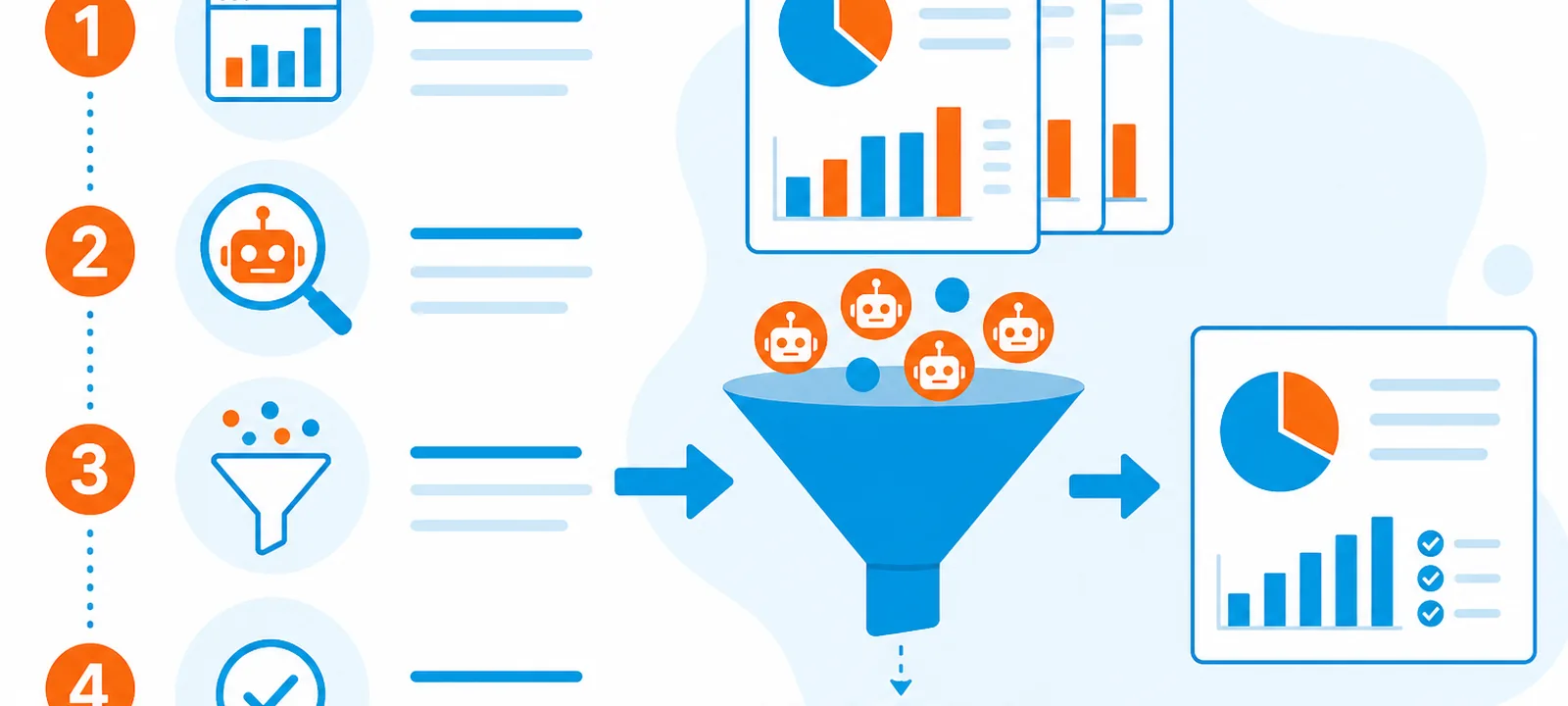
Google Ads bot accounts waste advertising funds, distort analytics, degrade Quality Scores, and lower conversion rates. They inflate costs while making campaign results look worse than reality. Without detection, Smart Bidding learns from fake engagement and may bid more on traffic that will never purchase. Monitoring protects both budget and optimization signals.
-
Solutions
-
 Click Fraud Protection
Block invalid clicks across every ad channel.
-
 Smart Bidding Protection
Feed Google clean, human-only signals.
-
 Clean Remarketing Audiences
Exclude suspicious traffic from your lists.
-
 All Features
Every ClickPatrol feature in one place.
-
 E-commerce & Retail
Protect shopping campaigns and product feeds.
-
 Service Providers
Stop wasted spend on local & lead-gen ads.
-
 Marketing Agencies
Classify, protect and train every client account.
-
 All Industries
Browse click fraud protection by industry.
-
 Small Business
Affordable protection that pays for itself.
-
 Enterprises
Scale protection across brands & accounts.
-
 Regional Companies
Keep local budgets on real, nearby buyers.
-
 Multinationals
Consistent protection across every market.
-
-
Agencies
-
For Agencies
Classify, protect and train every client account.
-
 Partner Program
Earn 15 to 25% recurring commission on linked clients.
-
 Case Studies
21 UK agencies unlocked over 6% media savings.
-
-
Resources
-
What is Click Fraud?
Learn what fake PPC clicks are and why they matter.
-
 Bot Traffic
Detect and block non-human clicks.
-
 Competitor Fraud
Stop rivals draining your budget.
-
 Sophisticated Fraud
Catch SIVT that native filters miss.
-
 Click Farms
Stop coordinated low-quality click operations.
-
 Invalid Traffic
Block every click that never converts.
-
 Help docs
How to connect Google Ads, GTM and other ad channels.
-
 FAQ
FAQ
Answers to the most common questions.
-
 Blog
Blog
Articles and guides from our expert team.
-
 Comparisons
ClickPatrol vs ClickCease and other tools.
-
 Tools
Tools
Free tools by ClickPatrol & Friends.
-
 About ClickPatrol™
Who we are and our mission.
-
Case Studies
Why agencies and businesses use ClickPatrol.
-
 Customer Reviews
Reviews and success stories from customers.
-
Partner Program
Join our affiliate & partner program.
-
 Contact us
Talk to our team about your ad traffic.
-
- Pricing
Google Ads bot accounts: Detection & prevention

Google Ads bot accounts are automated programs that click or view ads while posing as real users. They cost advertisers money in four main ways: click bots drive up paid clicks without buying intent, impression bots dilute pay-per-impression campaigns, conversion bots fill in forms to fake results, and proxy bots rotate IP addresses to slip past filters. The traffic comes from click farms, fraudulent publishers, and sometimes competitors trying to drain a rival's budget.
Google filters part of this traffic automatically and credits invalid clicks back, but plenty gets through. Advertisers who want clean data still need their own checks: watch for CTR spikes without matching conversions, review traffic sources and IP ranges, and block repeat offenders with IP exclusions or a dedicated click fraud tool.
Bot accounts range from simple scripts that hammer the same ad to software that simulates human browsing, mouse movement, and session depth. The rest of this article covers what each bot type does, the signals that give them away, and the prevention steps that work.
The effects of bot accounts on Google Ads campaigns
Bot accounts can harm Google Ads campaigns in multiple ways, including long-term strategy, budget allocation, and the accuracy of performance data. Some effects include:
Increased advertising costs.
Advertisers pay for clicks that do not generate user interest or conversions because bots artificially exaggerate click-through rates (CTR). Consequently, companies are wasting their advertising budget on users who do not exist. This can be expensive for high-volume keywords, where even a tiny portion of bot-driven hits can add up to a substantial amount.
Distorted analytics.
Bot traffic distorts ad campaign data, making it challenging to determine actual user behavior. Suppose bots account for a sizable percentage of ad clicks; measures like conversion rates, CTR, and bounce rates are less reliable. This affects marketers' capacity to optimize campaigns properly since decisions based on erroneous data might result in poor targeting and a worse return on investment.
Reduced conversion rates.
Bot accounts boost the clicks without increasing conversions because they rarely produce meaningful conversions. Due to the decreased conversion rate, Google Ads may penalize the campaign by raising the cost per click (CPC), further increasing the financial burden and lowering Quality Scores.
Reduced quality scores.
Google evaluates the quality and relevancy of advertisements using the Quality Score. Since bot clicks do not result in real engagement, the Quality Score may drop, raising the CPC. This reduces the campaign's effectiveness and may make it more difficult for advertisements to reach prospective clients during premium ad slots.
Brand reputation damage.
Bots who visit websites or click on advertisements only to "bounce" off without engaging might send signals that reduce a brand's relevance or credibility. By inflating bounce rates and decreasing interaction, bots can give the false appearance that users are uninterested in the brand, resulting in misunderstandings regarding consumer interest.
How Google ads bot accounts operate
Bot accounts work in a variety of ways, frequently designed to evade detection systems:
- Impression bots are for generating impressions without causing users to click on advertisements. They raise the ad's visibility without attempting to engage or convert, which reduces the effectiveness of pay-per-impression efforts.
- Click bots: These are more advanced bots designed to click on advertisements to increase click-through rates without any real user intent artificially. They are frequently employed to waste advertisers' expenditures and raise CPC prices.
- Conversion bots simulate post-click actions, such as completing transactions or forms. Although less common, conversion bots are more challenging to detect and cause advertisers to waste resources on users who do not engage with the brand or its products.
- Proxy bots: These bots pose as distinct individuals each time they click on an advertisement, using different IP addresses to evade detection. This allows them to get past Google's automated filters, which look for patterns such as repeated clicks coming from the same IP address.
Bot traffic versus invalid traffic: what is the difference?
The two terms get used interchangeably, but the distinction changes how you fix the problem.
- Invalid traffic is the widest category. Google defines it as clicks or impressions generated by any means that artificially inflate an advertiser's costs or a publisher's earnings. See invalid traffic for how Google classifies and credits it.
- Bot traffic is a subset of that: non-human activity from scripts or botnets imitating a real user at scale.
- Click fraud is the intentional kind, bot or human, aimed at draining an advertiser's budget or inflating a publisher's revenue.
Google's filters catch a share of the first category automatically. What lands in your reports is what those filters did not classify.
How to spot Google Ads bot activity
Although it might be difficult, identifying bot traffic is essential for advertisers seeking to maximize their ad spend. The following indicators and techniques help to identify Google Ad Bot activities:
Examine click-through rates for abnormalities
A sharp rise in CTR, particularly in the absence of a commensurate rise in conversions, may be a sign of bot activity. For instance, it is worthwhile to examine an ad if its CTR rises from 2% to 10% overnight without a corresponding increase in conversions.
Examine IP addresses and traffic sources
Bot traffic frequently comes from dubious IP ranges or geographical areas unrelated to the brand's intended market. Given that Google Ads and analytics offer methods for analyzing regional data, a sizable volume of visitors from unexpected places could indicate the presence of bots.
Track session length and bounce rates
Bots typically generate high bounce rates and short session durations because they rarely engage with content. You can notice bot presence by looking at site engagement metrics such as bounce rates, time spent on a page, and the number of pages seen in a session.
Make use of ad verification tools
Third-party click fraud tools watch every click on your ads in real time and score it against known bot signatures, IP reputation, and behavior patterns. ClickPatrol does this for Google Ads accounts and pushes exclusions back into the account automatically, so flagged sources stop seeing your ads instead of only showing up in a report.
Examine conversion data
Low follow-through rates combined with high conversions from your ads may indicate bot activity, mainly if the conversions originate from forms or other simple lead-generation processes for bots to complete.
Where bot traffic hits hardest: Display and Performance Max
Search campaigns are the easiest to police, because you can see the query and the placement. Display and Performance Max are not.
Performance Max runs across Display and YouTube, where inventory is highly automated, and it does not give you the placement-level reporting that standard Display campaigns do. Bots that slip through therefore show up as a performance pattern rather than a visible source: clicks without conversions, or engagement that shifts without any campaign change.
A related problem is Made-For-Advertising sites. MFA sites look like ordinary blogs or news sites, but the content is thin and repetitive, built to generate pages and ad slots rather than to inform anyone. That traffic can be technically human while carrying no buying intent, so you see respectable click-through rates, almost no conversions, and your ads sitting next to low-quality content.
How bot traffic corrupts Smart Bidding
This is the part that outlasts the wasted spend. Target CPA, Target ROAS and Maximize conversions all learn from conversion behaviour. Feed them clicks that never convert and the measured conversion rate drops, so the system bids down on placements and audiences that were performing fine. Fake or misfired conversions do the reverse and push budget toward the worst traffic in the account.
The damage outlives the traffic, because the strategy keeps optimising against the polluted history until enough clean data accumulates. That is why smart bidding protection matters more than a refund: a credit returns the money, not the learning.
Strategies for preventing Google Ads bot accounts activities
Maintaining the accuracy of your campaign statistics and safeguarding your ad budget depends on stopping bot activity. The following are some practical methods to reduce bot interference:
Rely on Google's invalid click filtering, but verify it
Google Ads filters known invalid traffic automatically and credits those clicks back to your account. That baseline protection catches obvious bots, not the sophisticated ones. Check the invalid clicks column in your account regularly, and report suspicious activity to Google when the numbers do not add up.
Employ IP exclusions
If you observe recurrent bot activity from certain IP ranges, use Google Advertisements' IP exclusion tool to block dubious IP addresses from viewing your advertisements. By blocking dubious IP addresses, you may save money and reduce bot clicks.
Optimize targeting preferences
You can reduce bot traffic by adjusting targeting parameters like audience targeting and geographic limits. For instance, you can exclude areas where your company does not operate to lessen the chance of bot interference.
Use CAPTCHA on conversion pages
By including CAPTCHA on forms or checkout pages, you can prevent bots from completing conversions and confirm human participation. It lessens the likelihood that bots will carry out the following actions, but it does not prevent them from clicking on advertisements.
Utilize third-party click fraud detection tools
Specialized tools such as ClickPatrol apply detection rules that go beyond Google's own filtering: device fingerprinting, click frequency caps, VPN and proxy checks, and geo rules you set yourself. By separating real visitors from bots at the click level, they keep budgets pointed at people who can actually convert.
The future of bot detection in digital advertising
Strategies for preventing bot activity are evolving along with digital advertising. Platforms like Google constantly improve their detection systems, but scammers are adjusting with ever-increasing sophisticated bot tactics.
As more companies shift their advertising budgets to digital platforms, enhanced machine learning algorithms and AI-driven bot-detection solutions will be essential to preserving the integrity and quality of ads.
Emerging technologies like blockchain may decrease fake ads by establishing transparent, verifiable advertising environments.
By confirming the legitimacy of every ad view or click, blockchain provides a decentralized way to track ad placements and validate impressions, potentially lowering fraud.
Managing bot activity to maximize campaign return on investment
Google Ads bot accounts greatly influence campaign effectiveness, analytics, and spending. Advertisers may protect their investments by understanding the different types of bot traffic, spotting warning signs of bot intervention, and implementing proactive detection and prevention techniques.
Utilizing technologies such as CAPTCHA, IP blocking, and third-party fake-click detection solutions can reduce bot clicks and ensure that advertising funds reach real audiences.
Businesses may safeguard their campaign ROI, preserve accurate analytics, and enhance the quality of their digital marketing efforts by proactively managing ad traffic as bot-detection technologies advance.
By remaining vigilant and informed, businesses can reduce the impact of bot accounts and concentrate on connecting with and interacting with actual users.
Frequently Asked Questions
Why worry about Google Ads bot accounts?
How do bot accounts operate in ads?
Bot accounts mimic user behaviors such as clicking ads, generating impressions, and submitting forms. They often originate from click farms, competitor sites, or malware-infected devices. Variants include impression bots, click bots, conversion fraud scripts, and proxy-backed automation. Together they simulate demand that exhausts budgets without producing legitimate customer outcomes.
Can Google detect bot clicks?
Google Ads includes invalid click detection for known bot traffic and may issue credits. Advanced bots still slip through, especially those using residential proxies or slow-drip patterns. Advertisers should monitor campaign data and add external click fraud detection when spikes, geo mismatches, or zero-engagement sessions persist despite Google's automatic filtering.
What signs indicate bot ad clicks?
Watch for repeated clicks from the same subnets, surges on low-intent placements, high CTR with no conversions, and sessions under one second in analytics. Bot traffic often clusters at odd hours or from datacenter ASNs outside your target geos. Cross-check Google Ads click reports with GA4 engagement before blaming creative or landing pages.