

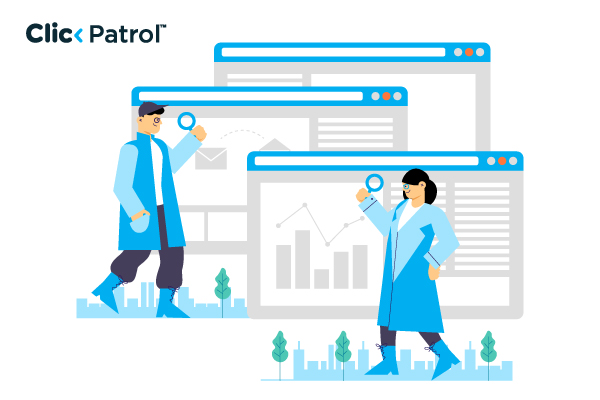
Ad Copy Scrapers are tools used to scrape or automate ad content, keywords, price-related information, and landing page content from PPC ads. Primarily, these are used to copy ad content and improve campaign strategies, thereby giving a competitive advantage.
- Agencies
-
About ClickPatrol™
-
 About ClickPatrol™
Who are we and read about our mission.
-
Affiliate Program
Sign-up for our affiliate program, we love to partner up with you.
-
Request Demo
Fill in this form to receive a demo and more information.
-
-
Resources
-
FAQ
Everything you need to know & answers to all the common questions.
-
Case Studies
See why agencies and business owners use ClickPatrol to protect their ads.
-
Customer Reviews
Customer Reviews and Success Stories of the ClickPatrol community.
-
Blog
Read articles and guides by our expert content team.
-
- Pricing
- Sign in
- Start Your Free 7-Day Trial
8 Ways to detect ad copy scraping in your PPC campaigns in 2026
Abisola Tanzako | Feb 19, 2026

Table of Contents
- Understanding ad copy scraping
- How ad scrapers operate
- Signs your PPC campaign may be scraped
- 8 Ways to detect ad copy scraping in your PPC campaigns
- 4 Advanced methods to detect ad copy scraping
- How ClickPatrol protects your PPC campaigns from ad copy scraping
- Case study: How ClickPatrol helped Conservio combat ad copy scraping
- Best practices to detect and prevent ad copy scraping
- Future trends in ad copy scraping and protection
- Taking action against ad copy scraping
Ad copy scraping is a hidden threat in PPC advertising, where competitors or automated bots copy ad content, pricing, and landing page information to gain a competitive edge.
While PPC provides businesses with quick access to traffic and conversions, its profitability makes it a target for malicious activity.
This guide explains how ad copy scraping works, its risks, detection techniques, and how solutions like ClickPatrol can protect your campaigns.
Understanding ad copy scraping
Ad copy scraping is an automated process of collecting your ads, keywords, landing pages, and pricing information by your competitors or bots.
Unlike other sources of traffic that visit your site, scraping bots collect your content for future use. Ad copy scraping is an automated process that is not visible.
It does not generate any conversions or engage with your ads as other users do. Instead, it silently monitors your ads and collects your data, giving your competitors an unfair advantage.
Types of ad copy scraping
- Ad text extraction: Bots extract ad text, including headlines, descriptions, and calls to action.
- Keyword discovery: Your competitors scrape the keywords that trigger your ads.
- Pricing scraping: Bots collect your pricing information from your landing pages.
- Offer reconstruction: Advanced bots can rebuild your sales funnel or even create copies of your ads based on the information they gather from your ads.
How ad scrapers operate
Knowledge of scraping mechanics is vital in recognizing scraping activities. Though not all scraping activities are malicious, competitive scraping is normally sophisticated enough to evade detection.
Automated harvesting
The activities of scrapers include mimicking search engine queries and systematically scraping search results, ad copy, and landing pages.
These bots behave like humans, making them difficult to track with conventional analytics.
API-Assisted collection
There are scraping tools that use APIs to efficiently retrieve campaign data. These tools can produce a large volume of data quickly.
Distributed networks
Scrapers typically use a series of IP addresses, either through proxies or a VPN, to evade detection. Conventional IP blocking does not work against scraping networks.
Human-like behavior
These bots behave like humans by using sophisticated algorithms, such as machine learning, making them difficult to track with conventional analytics.
They can behave like a human by pausing, moving the mouse cursor, or clicking a link.
Signs your PPC campaign may be scraped
The difficulty of identifying ad copy scraping lies in the fact that the bot mimics natural traffic patterns.
However, some patterns and anomalies can help identify ad copy scraping.
Unusual traffic patterns
Some unusual patterns that can be identified by analytics include:
- Sessions from unusual geographic locations.
- Increase in traffic during off-hours with no changes made to the ad copy.
- High page views with low engagement or no conversions.
Sudden competitor ad similarity
If you notice that your competitors have copied your ad copy or promotions, it could indicate ad copy scraping.
Any form of similarity to your ad copy or promotions should be taken seriously.
CPC is on the rise without an apparent reason
A CPC increase when quality scores, targeting, and bids are unchanged could be a sign that scraping is artificially increasing competition.
Gaps between impressions and conversions
Unusually high impressions and lower-than-expected conversions could be a sign that bots are clicking ads but not converting, wasting money, and providing misleading data.
Bots disguised as users
Scrapers are often hidden within analytics as human traffic. Some common signs of scraping include:
- High bounce rates
- Little interaction with interactive elements
- Non-converting traffic
8 Ways to detect ad copy scraping in your PPC campaigns
To identify ad copy scraping, advertisers need to leverage analytics, server tracking, and behavior analysis.
Analyze traffic metrics
Compare PPC traffic to past performance and organic traffic standards. Look for discrepancies in:
- Bounce rates
- Session duration
- Pages per session
- Conversion rates
Segment traffic by IP and user-agent
Review server logs for:
- Multiple hits from cloud provider IP addresses
- Unusual user agents
Inconsistent reverse DNS lookups
Typical patterns across multiple campaigns can indicate scraping activity.
Monitor interaction behavior
Heatmap and session recording tools can help identify unusual patterns such as:
- Limited scrolling and clicking
- Consistent and repetitive navigation
- Unusual activity timing
Monitor crawl frequencies
Heavy crawling of ad or product landing pages may indicate scraping. This can be identified by monitoring the crawl frequency.
Detect repeated ad fetches
Bots usually repeatedly fetch pages containing PPC content. This results in specific patterns in the server logs.
Examine referrers
Scrapers usually have empty or malformed referrers. Filtering these sessions may help identify the issue.
Analyze performance trends
Regularly monitoring CPC, conversion rate, ad positions, and impression share may help identify unusual patterns if the scraper is affecting your advertising strategy.
4 Advanced methods to detect ad copy scraping
To effectively identify sophisticated scraping activity, advertisers need more than basic analytics.
These advanced methods use automation, behavioral profiling, and machine learning to spot bots and protect campaigns in real time.
- Manual detection (limited scalability): While log files and analytics provide insights into scraping activities, they can also be laborious and impractical for widespread, diversified PPC campaigns.
- Session fingerprinting: Automated tools can analyze each user’s sessions, helping create behavioral profiles to identify anomalies, such as bots/scraping.
- Behavioral analysis: monitors metrics such as time intervals between actions, mouse clicks, scrolling activity, and click frequency to distinguish genuine users from bots/scripts.
- Adaptive threat intelligence uses machine learning to identify new and evolving scraping methods in real time, enabling a quick response to halt data theft and protect the campaign.
How ClickPatrol protects your PPC campaigns from ad copy scraping
ClickPatrol is designed specifically to target ad copy scraping. The strategy involves:
- Behavioral fingerprinting: Tracking mouse movements, browsing patterns, session times, and interaction levels to detect non-human behavior.
- Real-time detection: Scraping activity is detected in real time using a combination of behavioral factors.
- Adaptive blocking: After a scraper has been identified, ClickPatrol can be used to disrupt sessions, display challenges, or block requests to shield ad copy, pricing, and landing pages.
- False positive minimization: ClickPatrol uses machine learning to minimize false positives, preventing legitimate users from being blocked.
Case study: How ClickPatrol helped Conservio combat ad copy scraping
Conservio is a nature-positive travel company that uses PPC campaigns to attract nature-positive travelers.
They observed that:
- The ad spend was high with low conversions
- Non-human traffic was suspected but hard to detect
- The ROI of the campaign was not improving despite optimizing targeting
Server log analysis using ClickPatrol showed that 14% of the clicks were from bots and automated software, including possible scraping activity. After using ClickPatrol, they observed that:
- Non-human traffic was blocked in real-time
- Ad spend was saved by about $1,940 per month
- Conversion rates improved, and ROI was optimized
Best practices to detect and prevent ad copy scraping
Preventing ad copy scraping requires ongoing vigilance and a proactive approach.
Implementing regular monitoring, using advanced tools, and coordinating across teams can help safeguard your PPC campaigns and ensure your ad spend reaches real customers.
- Regular log analysis: Check server and PPC logs regularly to identify unusual trends or activity.
- Bot management tools: Use adaptive tools to differentiate between human and bot activity.
- Audit PPC performance trends: Continuously monitor CPC, conversion rates, impressions, and other metrics.
- Secure content delivery: Ensure content and metadata are not easily accessible.
- Cross-functional team approach: Marketing, analytics, and programming teams should collaborate to identify detection methodologies.
Future trends in ad copy scraping and protection
As ad copy scraping becomes more sophisticated, modern bots and automated systems are evolving to mimic human behavior and gather competitive intelligence across multiple platforms.
Staying ahead requires proactive detection, adaptive blocking, and advanced machine learning to protect campaigns effectively.
- AI-powered scraping: Modern bots use artificial intelligence to emulate human behavior as closely as possible, making it difficult for conventional tools to detect their presence.
- Automated competitive intelligence: Scraping data is being integrated directly into the bidding algorithms, thus helping the competition modify their ad strategies, pricing, and keyword targeting in real-time.
- Cross-platform scraping: The competitor scrapes ad copy/campaign information across various PPC ad channels simultaneously to achieve a comprehensive competitive overview.
- Proactive detection and adaptive blocking: Sophisticated detection capabilities, including machine learning, are increasingly vital for detecting potential attacks early and ensuring campaign integrity.
Taking action against ad copy scraping
As ad scraping tools evolve and become increasingly sophisticated at mimicking genuine user behavior, traditional ad scraping detection strategies cannot be relied upon alone.
Observations such as changes in traffic flow patterns, higher cost per click, and increasing similarity among competitors’ ad copy are signs of ad scraping.
Thus, by analyzing performance, behavior, and detection techniques, advertisers can prevent scraping before any serious damage to their data occurs.
With solutions such as ClickPatrol, advertisers may protect their ad copy, pricing data, and landing page data from exploitation using non-human detection techniques.
Prevent scrapers from stealing your marketing strategies or eroding your ad budgets. Keep your PPC accounts secure with ClickPatrol against automation scrapers.
Frequently Asked Questions
-
What is Ad copy scraping in a PPC Campaign?
-
How can businesses prevent ad copy scraping?
Ways to avoid ad copy scraping include monitoring behavior, reviewing server logs, monitoring PPC performance issues, and using bot-detection software. Such software includes ClickPatrol, which can help identify non-human activity and prevent ad copy scraping before valuable information is stolen.



- Chamber of Commerce: 71448519
- VAT: NL858719423B01

-
- Get Started
- Plans & Pricing
- Start Your Free Trial
- Book a Demo
- Sign in
-
- Partners
- Become Affiliate
- For Agencies
- For Brands
Trusted by thousands of advertisers worldwide